Yield Gap & Farm Yields: 7 Ways to Increase Crop Yield
Meta Description: “Yield gap and farm yields are central to ensuring increased crop yield and global food security. Explore 7 sustainable strategies, data-driven yield analysis, and emerging technologies to close the yield gap in 2025 and beyond.”
Table of Contents
- Introduction: The Yield Gap Challenge in Global Agriculture
- Defining the Yield Gap and Its Significance
- Yield Analysis: Identifying Constraints and Opportunities
- Comparison Table: Crop Yield Improvement Strategies
- 7 Ways to Increase Crop Yield for 2025
- Farmonaut’s Role in Advancing Yield Analysis & Sustainable Agriculture
- Outlook: Closing the Yield Gap in 2026 & Beyond
- Frequently Asked Questions (FAQ)
Introduction: The Yield Gap Challenge in Global Agriculture
As our population surpasses 8 billion in 2025, the challenge of producing sufficient food for all, while ensuring sustainability, has never been greater. With intensified pressure on agricultural systems to produce more, efficiently and sustainably, we must turn our attention to the central concept of the yield gap. This difference between potential and actual crop production underpins the ongoing challenge facing farmers, agricultural policymakers, and food systems worldwide.
In this comprehensive guide, we delve into the definition, significance, and latest advances in closing the yield gap, discuss yield analysis and its modern tools, and provide readers in 2025 and beyond with 7 proven, sustainable strategies for increased crop yield. We also showcase how data-driven platforms like Farmonaut empower smarter decisions and boost both productivity and resilience.
Whether you’re a grower, advisor, agriculture executive, or policy stakeholder, understanding and addressing the yield gap is pivotal for food security, climate resilience, and the sustainability of our planet.
Defining the Yield Gap and Its Significance
Yield gap refers to the difference between an area’s potential crop yield—what could be achieved under ideal management and environmental conditions—and the actual yield that is currently harvested by farmers. This gap emerges from a combination of factors, both human (including suboptimal practices, management, knowledge gaps, limited access to quality inputs) and environmental (such as disease, pest pressures, soil degradation, climatic stresses like drought or flooding).
Globally, studies reveal that farm yields often attain only 50–70% of their potential. The remainder—sometimes a significant portion—represents untapped productive capacity that could, in practical terms, boost food availability and supply if successfully closed. Addressing yield gaps is therefore not only a technical, but also a social, economic, and environmental imperative as we advance toward 2026 and beyond.
- ✔ Yield gap is a central concept for optimizing resource use and ensuring maximum production without expanding cultivated land.
- 📊 Data-driven analysis is necessary for identifying limiting factors and precise interventions.
- ⚠ Risk: Focusing on yield alone can sometimes result in “over-farming”—which must be counteracted by sustainability best practices.
- ✔ Sustainable yield improvements can reduce environmental footprint and save biodiversity.
- 🌱 Closing the yield gap directly increases food security and supports stable food markets for rural livelihoods.

Yield Analysis: Identifying Constraints and Opportunities
Yield analysis is the systematic assessment of all factors limiting current production relative to what is possible under optimal conditions. The process involves extensive data gathering through field trials, remote sensing technology, and farm surveys—aiming to identify nutrient deficits, water inaccessibility, pest outbreaks, soil health limitations, or unadapted crop varieties.
The continuous development and adoption of technologies such as high-resolution satellite imagery, drones, and IoT soil and weather sensors have revolutionized yield analysis. These tools permit near real-time monitoring of crop health, canopy cover, and soil moisture at field, regional, or even national scale.
In the context of crop nutrition, for instance, soil testing and targeted fertilization schemes can improve yields significantly in areas with critical nitrogen, phosphorus, or micronutrient limitations. Meanwhile, advances in breeding for stress-tolerant varieties (drought, heat, salt, and pest resistance) offer promise for narrowing the gap in regions facing severe climatic unpredictability.

Emerging digital tools—AI, machine learning, and analytics—are unlocking the potential for precise yield analysis in 2025 and beyond.
- 📊 Machine learning models analyze vast datasets to predict yield outcomes and recommend adaptive interventions tailored to specific conditions.
- 🌍 Remote sensing enables yield gap mapping at landscape or regional scales for more effective targeted resource allocation.
- 🌐 APIs like Farmonaut Satellite API let agri-tech companies, research teams, and governments integrate agri-environmental analytics into third-party platforms—speeding up diagnostics and data-driven action.
- 🔬 Laboratory soil testing and in-situ smart sensors complement remote sensing, leading to a full-spectrum understanding of the current yield limiting scenario.

Comparison Table of Crop Yield Improvement Strategies and Their Estimated Impact
| Strategy | Estimated Yield Increase (%) in 2025 | Resource Optimization Potential | Sustainability Impact | Comments |
|---|---|---|---|---|
| Precision Agriculture | 10–20% | High | Very High | Uses real-time data for targeted input application, reducing waste and boosting yields. |
| Drought-resistant Seed Varieties | 12–25% | Medium–High | High | Mitigates risks from unpredictable climate, especially in arid regions. |
| Soil Health Management | 10–18% | High | High | Improves long-term productivity; supports carbon sequestration. |
| Integrated Pest Management (IPM) | 8–15% | Medium | High | Reduces pesticide use, supports biodiversity, and decreases production losses. |
| Crop Rotation | 7–13% | Medium | Very High | Balances nutrient use, prevents soil exhaustion, breaks pest cycles. |
| Data-driven Irrigation | 12–22% | High | Medium–High | Maximizes efficiency in water use; crucial in regions facing drought or limited resources. |
| Satellite-assisted Monitoring | 10–18% | Very High | High | Enables frequent monitoring and rapid decision-making; scalable from local to regional levels. |
Yield Gap & Farm Yields: 7 Ways to Increase Crop Yield in 2025
For 2025 and the years to follow, closing the yield gap requires a combination of on-farm changes and systemic shifts. Here are seven strategies for increasing crop yield and narrowing the yield gap, based on the latest scientific, technological, and practical knowledge:
1. Improved Agronomic Practices
Enhancing farm yields starts with the adoption of better agronomic practices, including:
- ✔ Conservation agriculture (minimal tillage, cover crops, residue management) for soil health and resilience.
- ✔ Crop rotation and intercropping – to balance nutrients and reduce pest cycles.
- ✔ Integrated pest management (IPM) – combining biological controls with minimal, targeted pesticide use.
- ✔ Optimized fertilization – tailored to actual crop needs via soil testing and site-specific recommendations.
By systematically improving these practices, yields can be elevated by 7–20%, often with reduced long-term input costs and improved ecosystem services.

2. Enhanced Seed Technology and Crop Varieties
Development and deployment of high-yielding, stress-tolerant crop varieties is essential for addressing climatic unpredictability and biotic factors. Innovations such as CRISPR gene editing are enabling precise improvements—fast-tracking the availability of seeds better suited to emerging challenges.
- 🌾 Drought and heat-tolerant seeds – vital for regions exposed to erratic rainfall and temperature shifts.
- 🦠 Bioengineered varieties with resistance to pests and diseases help reduce input costs for pesticides and limit losses.
- 🌱 Cultivars adapted to local conditions often exhibit superior yield performance over generic varieties.
Access to the Crop Plantation and Forest Advisory ensures farmers receive insights tailored to their location-specific conditions and seed technologies.
3. Improved Access to Quality Inputs & Extension Services
Ensuring farmers—especially smallholders—have access to high-quality seeds, fertilizers, modern tools, and extension services is pivotal for bridging knowledge gaps and adopting best practices. Robust extension services demystify new techniques, help troubleshoot problems, and support compliance with sustainable standards.
- ✔ Mobile and web-based advisory platforms increase service availability and reach in rural areas.
- ✔ Satellite-based verification for crop loans and insurance democratizes access to financing and reduces fraud.
- ✔ Blockchain traceability increases market access and transparency for high-value products.
For businesses, fleet and resource management tools streamline logistics, reducing operational costs in advanced agriculture sectors.
4. Water Management and Efficient Irrigation
In regions where water scarcity is a key constraint, yield losses from moisture stress are common. Data-driven irrigation systems, such as drip and precision sprinklers, deliver water (and often nutrients) directly to plant roots when and where needed—significantly reducing waste and boosting returns.
- 💧 Soil moisture monitoring via IoT sensors or satellite remote sensing provides actionable data for better irrigation scheduling.
- 💧 Rainwater harvesting and micro-irrigation networks can further boost resilience on rainfed lands.
Explore Farmonaut’s Carbon Footprinting to track and reduce carbon emissions associated with water use in agriculture.

5. Integrated Pest and Disease Management
Pest and disease pressures account for substantial yield losses globally—often up to 30–40% in vulnerable cropping systems. Integrated Pest Management (IPM) combines biological, mechanical, and chemical controls in a targeted manner to maximize efficacy and minimize resistance and off-target impacts.
- 🐞 Encourage natural predators and beneficials to control pests organically.
- ⚗️ Utilize targeted, minimal chemical interventions only as needed, based on real-time pest scouting and forecasting.
- 🦠 Deploy disease-resistant varieties where available; rotate crops to break pathogen cycles.
Data-driven platforms employing satellite monitoring and machine learning, like those available via Farmonaut Web Platform, are vital for early warning and rapid response to outbreaks.

6. Policy, Infrastructure, and Institutional Support
No strategy to close the yield gap can succeed without strong policy and institutional support. This includes:
- ✔ Investment in rural infrastructure (storage, transport, technology access, and marketplaces).
- ✔ Credit and subsidy schemes for small and medium farmers, facilitating the adoption of new technologies and high-quality inputs.
- ✔ Robust extension services and climate adaptation funds, especially in climate-vulnerable regions.
Having real-time data via satellite is critical for governments and institutions managing nationwide food security programs and rural development agendas.
7. Digital Tools, Remote Sensing, and Satellite-based Crop Monitoring
The next leap in yield gap analysis and increased crop yield comes from integrating digital tools into farming systems. Farmonaut’s platform is at the vanguard of this revolution, offering:
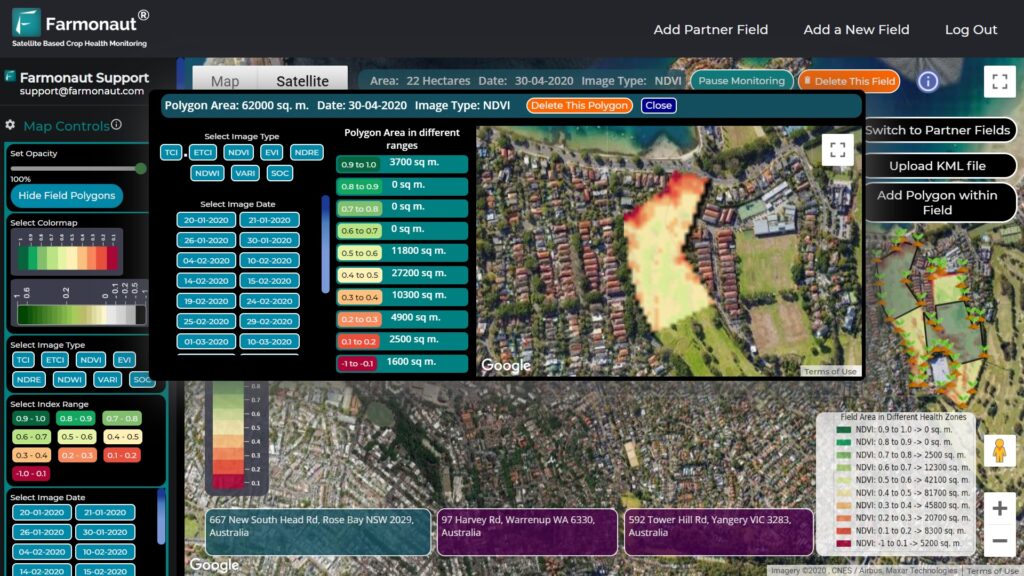
- 🛰️ Satellite-driven monitoring of crop health, soil moisture, and field operations, accessible via Android, iOS, web apps, and API.
- 📡 Real-time NDVI data for vegetation health, enabling early intervention in stress zones.
- 🤖 AI & Machine Learning-driven Jeevn AI for actionable advisories, harvest forecasting, and adaptive field management.
- 🔗 Blockchain for traceability and transparent resource management.
These tools empower farmers, businesses, and governments to optimize resource use, reduce losses, make adaptive decisions, and advance on the journey to closing the yield gap.




Farmonaut’s Role in Advancing Yield Analysis & Sustainable Agriculture
As we strive to bridge the yield gap and ensure increased crop yields for 2025 and beyond, Farmonaut stands out as an accessible, affordable, and globally scalable solution provider. We focus on enabling smarter, more sustainable agricultural decisions—whether it’s monitoring crop health, tracking carbon footprint, integrating blockchain traceability, or optimizing fleet and large-scale farm operations.
- ✔ Modular satellite insights for field-to-farm-to-region monitoring, adaptable to user needs.
- 📊 AI-based advisory (Jeevn AI) for in-season, situation-specific interventions and resilience strategies.
- 🌱 Blockchain traceability to build trust, demonstrate sustainability, and comply with emerging global standards.
- 📡 API access for integration with custom software platforms or institutional databases. See our API Developer Docs.
- ♻️ Real-time environmental monitoring—including tools for carbon footprinting—to enable compliance with sustainability certifications.
We believe that democratizing satellite and data-driven solutions is the key to advancing globally resilient food systems and rural prosperity for the decades ahead.

Getting Started: Farmonaut’s Subscription Options
Sign up for our flexible, scalable solutions—from individual field monitoring to multi-region agri-data services. Farmonaut offers simple subscriptions for users of any size, available via mobile, web, or API.
Key Components for Sustainable Yield Gap Reduction
- 🔍 Frequent monitoring of crop and soil conditions (remote sensing, field scouting)
- 🚰 Resource-efficient irrigation and water management (data-driven scheduling)
- 🌾 Diversification and improved seed technologies adapted to local constraints
- 🔬 Science-backed nutrient and pest management plans (integrated and adaptive)
- 📈 Use of digital decision tools for rapid, data-supported farm management
Farmonaut’s Value-Added Services at a Glance
- 🌐 Multi-sector application: Agriculture, mining, infrastructure, and defense manager dashboards
- 📊 Environmental impact tracking: Carbon footprint monitoring, ecosystem health indicators
- 🔗 Blockchain traceability: Supply chain transparency and product authentication
- 🚜 Fleet/resource monitoring: Efficient logistics, cost reduction, improved sustainability
- ⏱️ Real-time data & AI-driven advisories: Timely, scalable, and modular services
Outlook: Closing the Yield Gap in 2026 & Beyond
The yield gap remains a defining challenge of our era, where pressures from population growth, climate unpredictability, and resource scarcity collide with our collective responsibility for food security and environmental stewardship. As these pressures intensify, closing the gap by optimizing input use, leveraging robust yield analysis, and targeting interventions scientifically becomes ever more essential.
Reducing the gap is not solely a technical exercise. It is as much an economic, social, and policy-driven endeavor as it is an agronomic challenge. Ensuring equitable access to tools, knowledge, and infrastructure for all farmers will ensure broader adoption and scalability.
As the agricultural landscape evolves between now and 2026, successful yield gap reduction efforts will likely include:
- Integrated, data-driven solutions tailored to local production constraints.
- Cross-scale monitoring and decision platforms combining field, satellite, and AI analytics.
- Stronger policy frameworks to support smallholders, incentivize sustainable practices, and improve rural-urban market linkages.
- Continuous crop breeding and technology adaptation targeting emerging climatic and resource constraints.
- Enhanced traceability, certification, and verification systems for supply chain authenticity and carbon sustainability.
In 2025, as global population and climate pressures surge, closing the yield gap through a mix of agronomic innovation, data-driven analysis, and supportive policies is more important than ever. Modern strategies—enhanced seed varieties, precision irrigation, targeted fertilization, integrated pest management, and adoption of digital tools—remain the backbone of resilient, sustainable, and productive agriculture.
Farmonaut’s mission is to make real-time, affordable satellite insights accessible to all, enabling scalable solutions for growers, agribusinesses, and governments worldwide. By empowering informed, adaptive management grounded in continual yield analysis, we help future-proof agriculture—securing food supplies and rural livelihoods while protecting our planet’s ecosystems.
Frequently Asked Questions (FAQ): Yield Gap, Farm Yields & Increased Crop Yield
What is the yield gap and why is it important?
The yield gap is the difference between an area’s possible (potential) crop yield under optimal conditions and the actual crops harvested. Closing this gap is crucial for boosting global food security, maximizing productivity, and minimizing the environmental footprint by avoiding farmland expansion.
Which regions are most affected by the yield gap?
The yield gap can be significant in South Asia, Sub-Saharan Africa, and rainfed regions experiencing drought or limited input access. However, almost all geographies, including developed countries, have some degree of yield gap due to variable management practices and climatic stress.
How can data-driven yield analysis help farmers?
Data-driven yield analysis uses satellite, AI, remote sensing, and field trial data to identify limiting factors, optimize input use, and recommend targeted interventions. This results in higher, more consistent yields and improved resource efficiency.
What are the most effective strategies for increasing crop yield?
Effective strategies include: precision agriculture, improved seed technology, integrated pest management, crop rotation, soil health management, efficient irrigation, and adoption of real-time monitoring tools like Farmonaut’s satellite and AI services.
How does Farmonaut support closing the yield gap in agriculture?
Farmonaut offers globally scalable, affordable solutions including satellite-based monitoring, AI advisories, blockchain traceability, and environmental impact tracking—to empower users with necessary data to maximize yields, reduce losses, and manage resources sustainably.