Soil Analysis & Sustainable Farming: Top Yield Insights for 2025 & Beyond
“Soil analysis can boost crop yields by up to 30% through targeted nutrient management and sustainable farming practices.”
“Sustainable farming methods are projected to improve soil health by 25% and reduce chemical use by 40% in 2025.”



Table of Contents
- Introduction: Why Soil Analysis & Sustainable Farming Matter in 2025
- Key Components of Soil Analysis for Farming and Sustainable Yield Enhancement
- Comparative Impact Table: Soil Analysis Metrics & Sustainable Outcomes
- Farmonaut: Satellite-Driven Solutions for Soil Analysis and Sustainable Agriculture
- Site-Specific Management: Precision in Inputs, Yield, and Eco-Safety
- Integrated Nutrient Planning and Organic Amendments
- Precision Irrigation, Drainage, and Soil Moisture Management
- Sustainable Seed Enhancement Through Soil Insights
- Best Practices for Soil Analysis in Sustainable Farming Systems: 2025 & Beyond
- FAQs: Soil Analysis, Sustainable Yield & Eco-Focused Resource Management
- Farmonaut Subscriptions
Introduction: Why Soil Analysis & Sustainable Farming Matter in 2025
The intersection of soil analysis and sustainable farming yield enhancement is pivotal for modern agriculture, forestry, and adjacent resource fields. With global food demands rising, environmental concerns intensifying, and regulatory frameworks tightening, understanding the foundational role of soil is more vital than ever. In 2026 and beyond, practitioners across agriculture, forestry, and even post-mining landscapes must leverage advanced soil analysis as a predictive tool—not simply a reactive task—for long-term productivity, ecosystem stewardship, and operational efficiency.
Effective soil analysis for farming unlocks actionable data: from precise nutrient profiling and pH management to organic matter monitoring, soil structure optimization, and contaminant risk reduction. These insights underpin healthier, higher-yielding crops, more resilient forests, and eco-friendly land management.
The synergy between accurate soil analysis, site-specific interventions, and sustainable amendments is projected to boost crop yields up to 30%, improve soil health by 25%, and reduce agrochemical inputs by 40% in the next agricultural cycle!

Key Components of Soil Analysis for Farming and Sustainable Yield Enhancement
Soil analysis is multifaceted, encompassing chemical, physical, and biological assessments. As we approach 2026, it’s critical to understand the following key components for integrating soil analysis into yield-enhancing and sustainable farming practices:
- 📊 Nutrient Profiling: Determines availability of nitrogen, phosphorus, potassium, calcium, magnesium, sulfur, as well as vital micronutrients (boron, zinc, iron, manganese, copper, molybdenum). Accurate profiling prevents deficiencies and optimizes input use.
- 🔄 pH and Buffering Capacity: A pH outside optimal crop range can “lock away” nutrients, while buffering capacity guides effective liming or acidifying interventions.
- 🌱 Organic Matter & Soil Biology: High organic matter improves water retention, cation exchange, and fosters microbial diversity critical for soil health and nutrient cycling.
- 🏗 Soil Texture & Structure: Proportions of sand, silt, clay, and the stability of aggregates (structure) influence drainage, compaction resistance, aeration, and root development.
- ⚠ Contaminants & Heavy Metals: Especially near mining or reclaimed forestry lands, routine screening for lead, cadmium, arsenic, hydrocarbons ensures safety, regulatory compliance, and healthy yields.
Interpreting these metrics relative to crop stage, planned rotation, or tree species ensures interventions are both productive and sustainable.
Combining traditional soil tests with digital tools and satellite insights allows for deeper, data-driven understanding of field variability and input needs.

Detailed Breakdown: Essential Soil Analysis Metrics
- ✔ Nitrogen, Phosphorus, Potassium (N, P, K): Primary nutrients, directly correlated with crop vigor and yield. Monitoring avoids both deficiencies and environmentally harmful excesses.
- ✔ Secondary & Micronutrients (Ca, Mg, S, B, Zn, Fe, Mn, Cu, Mo): Small in quantity, large in their influence on plant development, disease resistance, and physiological processes.
- ✔ pH: Critical for nutrient availability. Most crops thrive between 6.0–7.5, but some trees or specialty crops demand specific pH ranges.
- ✔ Organic Matter & Cation Exchange Capacity (CEC): High organic matter improves the soil’s ability to retain nutrients and moisture, supporting healthy microbial communities.
- ✔ Texture & Compaction: Determines water infiltration, aeration, root resilience, and machinery impact. Sand-rich soils drain quickly but hold fewer nutrients, while clay soils can compact and poor structure impedes growth.
- ✔ Heavy Metals & Contaminant Residues: Even trace amounts can depress yield and render crops unsafe, underscoring the need for advanced analysis in mining-adjacent or reclaimed areas.
Focusing solely on topsoil. For perennials and forestry, deeper (20–60 cm) soil layers hold crucial clues about nutrient reserves and compaction, impacting long-term productivity.
Comparative Impact Table: Soil Analysis Metrics & Sustainable Outcomes
The following table demonstrates the estimated effects of core soil analysis metrics on crop yield improvement, soil health, and eco-friendliness for sustainable farming practices projected into 2025 and beyond:
| Soil Analysis Metric | Estimated Yield Increase (%) | Improvement in Soil Health Score | Eco-Friendliness Rating (1–5) |
Example Sustainable Farming Practice |
|---|---|---|---|---|
| pH Optimization | 10–25% | +2.0 | 5 | Liming acidic soils to boost nutrient availability |
| Organic Matter (SOC) Management | 15–30% | +3.5 | 5 | Compost addition, green manuring, cover crops |
| Nitrogen (N) Optimization | 10–28% | +2.0 | 4 | Variable-rate fertilizer application, crop rotation with legumes |
| Phosphorus (P) Balancing | 7–18% | +1.0 | 3 | Applying rock phosphate, recycling crop residues |
| Texture and Compaction Control | 8–15% | +1.5 | 4 | Reduced tillage, deep ripping, controlled machinery traffic |
| Heavy Metals & Contaminants Mitigation | 5–10% | +2.5 | 5 | Phytoremediation, targeted amendments, crop selection |
Farmonaut: Satellite-Driven Solutions for Soil Analysis & Sustainable Yield Enhancement
As a leading satellite technology company, we at Farmonaut have made it our mission to empower agriculture, forestry, and resource managers with data-driven, affordable, and accessible solutions for soil analysis and sustainable farming yield enhancement.
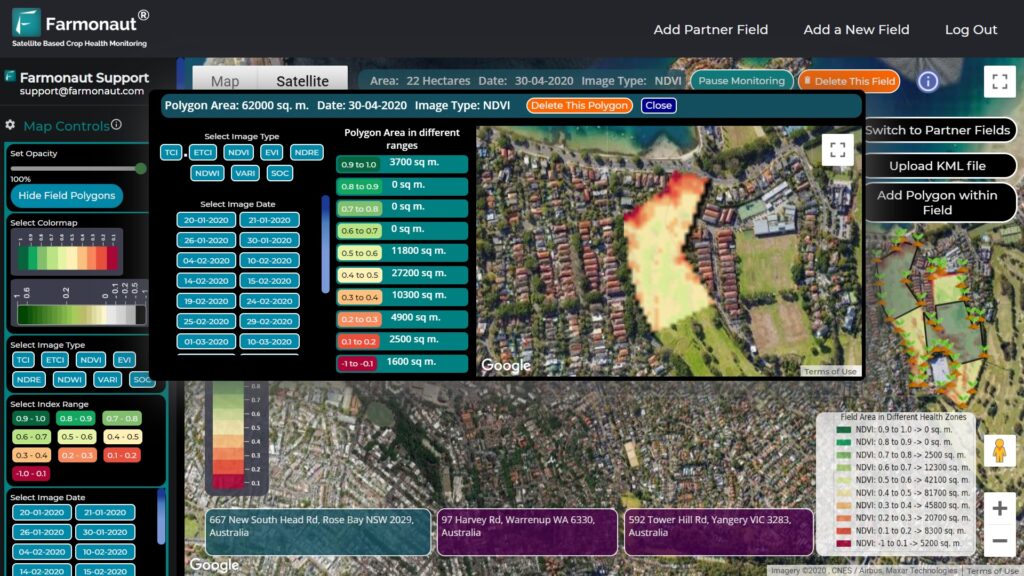
- 🛰 Satellite-Based Monitoring: Real-time, actionable soil status, vegetation health, and nutrient mapping via our web, Android, iOS apps, and API.
- 🤖 AI Advisory Systems: Our Jeevn AI synthesizes soil data and weather insights to recommend precise input schedules and eco-friendly interventions.
- ⛓ Blockchain Traceability: Secure traceability for resource flows, ensuring transparency from soil to harvest and beyond.
Learn more about Blockchain Traceability for food safety and compliance → - 🌍 Environmental Impact Monitoring: Carbon footprint and resource usage metrics for compliance and sustainability.
Explore our Carbon Footprinting tools for sustainable forestry and farming → - 🚜 Fleet & Resource Management: Optimize logistics, reduce fuel use, and ensure safer farm & mining equipment movement.
See how Fleet Management makes agribusinesses more efficient → - 💼 Large Scale Farm Management: Our Agro Admin App supports large agri-enterprises and plantation management for monitoring, planning, and operational control.
Manage your entire farm or forestry business via Agro Admin → - 📑 Integrated APIs: Developers and agri-tech businesses can seamlessly integrate our remote-sensing and weather API for custom analysis or tools.
API Access: Access Farmonaut’s API platform | API Developer Docs

Investing in precision soil analysis and eco-sustainable yield systems not only increases production value but also assures long-term land resources stability—an essential metric for agribusiness and post-mining recovery portfolios.
Site-Specific Management: Precision in Inputs, Yield, and Eco-Safety
Using soil analysis and sustainable farming yield enhancement as a cornerstone, 2025’s most successful farming and forestry systems will adopt site-specific management. This approach couples granular soil data with geospatial mapping and real-time advisory for targeted interventions. Benefits include:
- 🌐 Precision Input Allocation: Soil maps at block or stand level guide variable-rate fertilizer, lime, and irrigation—minimizing waste and leaching.
- 🚩 Early Detection of Soil Fertility Trends: Proactive monitoring detects declining nutrient or pH status, enabling timely, site-tailored remediation.
- 🛡 Risk Mitigation: Routine contaminant screening ensures regulatory compliance and yield safety—especially in mining-adjacent or high-risk reclaimed lands.
- ⏳ Long-term Sustainability: Adaptive management strategies based on evolving soil analysis data help preserve soil health and resource value across decades.
Site-specific soil analysis isn’t just about yield today—it’s foundational for multi-year sustainability and resilient productivity amid climate uncertainty in 2026 and beyond.

Integrated Nutrient Planning and Organic Amendments
Fusing Soil Analysis, Crop Modeling, & Organic Matter Enhancement
- 🌾 Combine Soil Tests and Crop Modeling: Translating soil nutrient status into actionable application plans using predictive modeling (YIELD CURVE alignment).
- 🟢 Green Manure and Cover Crops: Using legumes and cover crops increases soil organic matter, boosts biological activity, and reduces the need for synthetic fertilizer.
- 🌱 Compost & Biochar Integration: Replenishes organic carbon, moderates pH, and strengthens microbial networks—core for sustainable soil structure and fertility.
- 🛡 Minimize Input Waste: Precision application ensures nutrients match the spatial-temporal crop and soil need, slashing runoff and optimizing resource use.
- ♻ Diversify Amendments: Consider local availability of compost, crop residues, and mineral amendments for cost-effective, sustainable soil management.

Visual List: Key Steps to Integrate Sustainable Nutrient Planning
- Test all essential nutrients, pH, and organic content.
- Model nutrient demand against soil supply each crop cycle.
- Adjust amendments and fertilizer by soil zone, not “one-size-fits-all.”
- Implement green manure, cover crops, and organic sources whenever viable.
- Monitor results and fine-tune further with digital and satellite tools.
Leverage Farmonaut’s Agro Admin App for large-scale, integrated management of amendments, fertilizer plans, and environmental impact metrics—all mapped to your actual farm blocks and resource flows.
( Explore Agro Admin →)
Precision Irrigation, Drainage, and Soil Moisture Management
Advanced soil analysis for farming increasingly factors in soil moisture, structure, retention capacity, and drainage—vital for productivity, especially in drought-prone or high-compaction systems. Responsive irrigation strategies, guided by real-time satellite and sensor data, stabilize yield and reduce water waste.
- 💧 Monitor Moisture in Real-Time: Platforms like Farmonaut integrate soil moisture indices for precise irrigation scheduling.
- 🏞 Match Watering to Texture: Sandy, silty, or clay soils require differentiated irrigation volumes and frequencies.
- 🔄 Enhance Structure for Resilience: Amendments (compost, cover crops) boost retention and boost root access to moisture between rains or watering cycles.
- ⚠ Drainage Control: Identify and remediate poorly drained zones to prevent root disease or yield loss—use deep sampling to spot compaction risks.
- 🌾 Drought Resistance: Timely monitoring helps fast-growing tree species and crops avoid yield drops during dry periods—critical for long-cycle forestry.

Integrated soil data and satellite-driven irrigation management cut water usage by up to 35%, improve yield stability, and future-proof farms against climate unpredictability—especially crucial by 2026.
Sustainable Seed Enhancement Through Soil Insights
The relationship between soil conditions and sustainable seed enhancement cannot be overemphasized. Soil preparation, nutrient balance, and moisture status at planting dictate seed vigor, germination rates, and early crop resilience.
Critical Soil Factors in Seed Success
- 🌱 Vigor & Germination: Balanced pH and adequate phosphorus at surface and subsurface layers maximize energy for strong, early root growth.
- 💡 Priming & Soil Compatibility: Seeds primed for rapid sprouting best reach their genetic potential when soils match their nutrient and moisture requirements—soil analysis guides both decisions.
- 🌳 Root Environments for Forestry/Perennials: Deeper soil analysis reveals both physical and chemical constraints, ensuring deep-rooting species thrive long-term.
- Sample soils at both surface and at planting depth before seasonal seeding
- Align seed selection & priming protocols with expected soil fertility and structure
- Apply tailored phosphorus or starter amendments only where indicated by soil test
- Monitor early growth; adjust fertility in real time leveraging satellite insights

Sustainable seed enhancement is most effective when coupled with site-specific soil diagnosing—pair soil testing, seed priming, and digital monitoring for optimal stand establishment in all resource fields, from agriculture and forestry to reclaimed mining sites.
📥 Seed & Soil Success Checklist for 2025:
- ✔ Sample soil at appropriate depth for target species and crop stages
- ✔ Match seed lot to soil pH and fertility profile
- ✔ Implement starter amendments only as needed per soil diagnostics
- ✔ Use living mulches or cover crops to maintain early-season soil stability
- ✔ Monitor emergence remotely with satellite & app-based digital tools
Best Practices for Soil Analysis in Sustainable Farming Systems: 2025 & Beyond
To genuinely maximize the benefits of soil analysis and sustainable farming yield enhancement, the next generation of systems must implement these best practices:
- ⚡ Routine & Deep Sampling: Go beyond annual, surface-only tests—sample at depth, and during critical crop transitions or rotations.
- 📶 Digital Data Integration: Merge soil test, weather, irrigation, and yield data into a centralized digital platform for adaptive management.
- 📝 Regulatory Compliance: Monitor trace metal and contaminant benchmarks according to local (or global export) standards; essential for food chain and forest product safety.
- 🎓 Capacity Building: Train field personnel in proper sampling, handling, and online interpretation to minimize errors and accelerate decision speeds.
- 🔄 Continuous Monitoring: Soil fertility and contaminant status can drift quickly, especially under high-intensity or reclaimed systems. Automated/AI monitoring detects issues early for timely intervention.
Over-reliance on DIY soil tests without expert interpretation may lead to misallocated inputs, missed regulatory compliance, or poor yield outcomes—always consult with data-backed, reputable advisory systems.
The drive towards digital soil monitoring platforms is accelerating as supply chain and ESG (Environmental, Social, Governance) compliance become boardroom priorities. The tools and strategies adopted now will define the market leaders of 2026 and beyond.
As outlined, prioritizing soil analysis, sustainable yield enhancement methodologies, and digital integration helps practitioners across agriculture, forestry, and land reclamation sectors realize heightened productivity, robust compliance, and environmental resilience well into the future.
Ready to transform your field, forest, or resource operation into a model of sustainable yield and eco-intelligence? Start leveraging high-precision, affordable, and user-friendly satellite assistance now:
Farmonaut Subscriptions
Farmonaut offers scalable, cost-effective subscription packages for individual users, agriculture and forestry businesses, mining operators, and governments. Whether you operate a small farm or a multi-site resource enterprise, our platform equips you with modern digital tools for high-impact soil analysis, fleet management, carbon tracking, and more.
FAQs: Soil Analysis, Sustainable Yield & Eco-Focused Resource Management
1. Why is soil analysis foundational in sustainable farming systems?
Soil analysis provides a comprehensive diagnosis of nutrient availability, pH, organic matter status, structure, and contaminant risk. This enables practitioners to tailor interventions, prevent waste, and safeguard soil health—making it predictive for yield and sustainability, not just reactive troubleshooting.
2. What’s the ideal frequency and depth for soil sampling?
Routine surface sampling should be done every season, with deeper profiling (20–60 cm) undertaken annually or before establishing perennial crops/forests. Combining surface and deep layers ensures you detect nutrient reserves, compaction, and contamination risks.
3. How do you balance yield enhancement with eco-friendliness?
By aligning nutrient applications, amendments, and irrigation to soil test zones, practitioners boost yields and dramatically reduce chemical leaching and runoff—protecting both crop value and the surrounding environment.
4. What makes Farmonaut’s approach different?
We at Farmonaut uniquely blend satellite-based remote sensing, AI-powered advisory, blockchain traceability, and digital resource management. Our unified system democratizes data-driven decisions while supporting regulatory compliance, sustainability, and operational efficiency.
5. Is digital soil and resource monitoring scalable for both small and large operations?
Absolutely. Our platform adapts to individual farms, large plantations, forestry holdings, and mining-reclaimed landscapes, making soil analysis and sustainable farming yield enhancement accessible for every user profile.
“Soil analysis and sustainable farming yield enhancement: your foundation for resilient agriculture, forestry, and resource fields in 2025 and beyond.”