7 Powerful Soil Management Strategies for 2026 Success
- Introduction: Why Soil Management is Essential in 2026
- Key Drivers of Sustainable Soil Management
- Core Principles & Practices in Soil Management
- The 7 Powerful Soil Management Strategies for 2026
- Comparative Overview Table: Strategy Impacts
- Sector-Specific Relevance: Soil Management Across Industries
- Measurement, Policy, and Digital Implementation
- Farmonaut: Satellite Technology for Next-Gen Soil Management
- FAQ: Soil Management for 2026
- Conclusion: Building Resilience, Productivity, and Sustainability with Soil
Introduction: Why Soil Management is Essential in 2026
Soil is the foundation of all terrestrial ecosystems, driving the productivity of agriculture, forestry, mining reclamation, and even infrastructure development. As we approach 2026, optimizing soil management is more relevant than ever. It is the linchpin connecting modern food systems, environmental stewardship, and resource security in a world facing growing population, climate change, and market pressures.
Soil health determines water retention, controls carbon cycling, regulates nutrient availability, and supports the biodiversity that underpins resilient, sustainable ecosystems. From feeding global communities to enabling responsible mining rehabilitation and providing the structural stability for infrastructure, robust soil stewardship is vital to the economic and environmental viability of our industries.
Let’s explore why sustainable soil management is the most relevant topic across sectors today, what drives the shift, and what key practices shape soil’s future. Plus, we’ll reveal 7 powerful, actionable strategies you need to know for 2026 success.

Key Drivers of Sustainable Soil Management for the 2026 Landscape
✔ Food and Fiber Security
- 🌾 Soils must sustain higher yields as the global population grows.
- 🔬 Precision agriculture, targeted nutrient applications, and regular soil testing enable us to tailor inputs to crop needs, boosting efficiency and lowering costs.
- 📉 Reducing input intensity helps minimize both production expenses and environmental impacts.
✔ Climate Resilience
- 🌎 Soils act as major carbon sinks, storing vast amounts of organic carbon and mitigating emissions.
- ⛈ Soil organic matter (SOM) improves water retention, soil structure, and drought tolerance, protecting lands from extreme weather events.
✔ Biodiversity and Ecosystem Services
- 🦠 Healthy soils host diverse microbial communities, mycorrhizal networks, and soil fauna that enhance nutrient cycling and effective pest regulation.
- 🌐 Supports a resilient, self-regulating agroecosystem, reducing reliance on synthetic chemistry.
✔ Regulatory and Market Pressures
- 📋 Emissions accounting, land degradation neutrality, and sustainability certifications incentivize better soil stewardship and require transparent reporting.
- 🔗 Heightened focus on resource traceability, audit trails, and environmentally responsible practices.

Core Principles & Practices in Next-Gen Soil Management
Understanding Soil Health Indicators
Improving soil management starts with data-driven guidance. The following indicators help assess soil health and drive sustainable decisions:
- 🟢 Soil organic matter (SOM) content: Measures a soil’s fertility, carbon sequestration, and water-holding potential.
- 📏 Aggregate stability & structure: Determines resistance to erosion and ability to support plant roots.
- 💧 Water infiltration rate: Indicates how efficiently water penetrates soils, impacting crop growth and leaching risk.
- ⚖️ pH & cation exchange capacity: Control nutrient availability and soil chemistry balance.
- 🔬 Microbial activity & earthworm abundance: Signal a biologically active, fertile ecosystem.
Embracing Nutrient and Water Management
- 🔍 Move beyond blanket fertilizer applications—use soil testing, tissue analysis, and crop sensors for precision input applications that improve efficiency and lower emissions.
- 🌱 Conservation tillage, cover crops, mulching, and contour farming reduce erosion, improve water infiltration, and build resilience.
Soil Biodiversity, Organic Matter, and Carbon
- 🦠 Reducing soil disturbance and applying organic amendments support diverse microbial communities and mycorrhizal networks.
- 🪱 Integrating crop rotations, agroforestry, and compost builds soil organic matter, enhances nutrient cycling, and increases carbon stocks.
Rehabilitation, Reclamation, and Restoration
- 🏞 Mining and land development require careful topsoil replacement, strategic seed mix selection, and application of microbial inoculants to restore ecosystem services and minimize liabilities.
The 7 Powerful Soil Management Strategies for 2026
Unlocking the full potential of soils demands an integrated, strategic approach. Here are 7 evidence-backed strategies every stakeholder in agriculture, forestry, and mining should prioritize:
1. Precision Nutrient Management
- 🔬 Use real-time data from soil and tissue tests, remote sensing, and crop models to apply nutrients only where and when they are needed.
- 🌱 Reduces emissions, minimizes leaching, and improves nutrient use efficiency for higher economic and environmental gains.
2. Conservation Tillage and Reduced Soil Disturbance
- 🚜 No-till or reduced-till systems protect the structure and organic matter content of soils, reduce erosion, and improve stability.
- 👍 Supports beneficial microbial networks, water infiltration, and root growth.
3. Cover Cropping and Crop Rotations
- 🌿 Grow cover crops between cash crops or forestry cycles to prevent erosion, fix nitrogen, suppress weeds, and boost SOM.
- 🔄 Rotating crops breaks pest and disease cycles, supports diversified soil biology, and optimizes nutrient use.

4. Organic Amendments: Composts, Manures, and Biochar
- 💚 Apply compost, animal manures, or biochar to increase SOM, boost microbial activity, and improve nutrient and water retention in soils.
- 🔥 These amendments enhance soil carbon stocks and build lasting fertility—critical for sustainable yields.
5. Agroforestry Integration and Perennial Systems
- 🌳 Combine trees with crops or grazed systems to create multi-layered, resilient landscapes that stabilize soils, recycle nutrients, and diversify outputs.
- 🔄 Tree roots hold soil in place, increase infiltration, and foster powerful mycorrhizal networks.
6. Erosion Control and Slope Stabilization
- 🏔 Contour farming, terracing, buffer strips, and targeted mulching reduce soil loss on slopes, adjacent to rivers, and in mining restoration areas.
- 🦺 These interventions maintain topsoil and prevent off-site sedimentation—crucial for protecting ecosystems and downstream infrastructure.
7. Land Rehabilitation and Reclamation
- 🌄 In mining or degraded lands, prioritize careful topsoil replacement, restoring native soil horizons, adding microbial inoculants, and re-establishing ecosystem services with diverse seed mixes and persistent cover.
- 🌱 Ensures productive post-mining land use, supports sustainable forestry, and reduces long-term liabilities and land degradation.
🚀 Top Benefits of Implementing the 7 Strategies:
- ✔ Enhanced soil health and structure for all sectors (agriculture, forestry, mining).
- ✔ Increased resilience to drought, extreme weather, and market change.
- ✔ Higher yield stability with lower input and emissions intensity.
- ✔ Reduced erosion and polluted runoff across landscapes.
- ✔ Improved ecosystem services—carbon storage, water purification, and biodiversity support.
📊 Key Data Insights for 2026:
- 📈 Precision nutrient management can improve input efficiency by up to 30%.
- 🪴 Cover cropping boosts organic matter by 0.1-0.5% annually in temperate soils.
- 🌲 Agroforestry can increase carbon sequestration by 0.5-2.0 t/ha/year.
- 💧 Improved infiltration rates help mitigate drought and reduce irrigation costs.
- 🌾 Soil rehabilitation following mining can restore up to 80% of pre-disturbance productivity within 10 years.

Comparative Overview Table: Seven Soil Management Strategies Side-by-Side
| Strategy Name | Primary Benefit | Estimated Soil Health Improvement (%) | Impact on Nutrient Cycling | Estimated Carbon Sequestration (t/ha/year) | Sector Most Benefited |
|---|---|---|---|---|---|
| Precision Nutrient Management | Boosts input efficiency and reduces runoff | 15–30% | High | 0.3 | Agriculture |
| Conservation Tillage | Improves structure, reduces erosion | 18–28% | Medium | 0.4 | Agriculture, Mining |
| Cover Cropping & Rotations | Limits nutrient loss, boosts SOM | 20–40% | High | 0.6 | Agriculture, Forestry |
| Organic Amendments | Enriches SOM, boosts resilience | 25–40% | High | 0.7 | Agriculture |
| Agroforestry & Perennial Systems | Promotes ecosystem services | 30–50% | Medium | 1.2 | Forestry, Agriculture |
| Erosion Control Measures | Protects topsoil, reduces sedimentation | 10–22% | Medium | 0.2 | Mining, Infrastructure |
| Land Rehabilitation & Reclamation | Restores productivity & ecosystem function | 40–80% | High | 0.9 | Mining, Forestry |

Sector-Specific Relevance: Soil Management Across Agriculture, Forestry & Mining
Agriculture and Farming
- 🌱 Soil health is a core performance metric: It underpins yield stability, input efficiency, resistance to drought/flood, and reduction in emissions.
- 💡 Adopt strategies like precision N management, inoculated legume rotations, cover cropping, and reduced-tillage for higher yields at lower costs.
- 🔗 Explore Farmonaut’s Large Scale Farm Management for satellite-driven real-time crop and soil health insights—boosting operational productivity.
Forestry and Agroforestry
- 🌳 Soil management boosts timber quality, improves disease & drought resilience, and incorporates perennial systems for maximum soil cover and structure protection.
- 🤝 Key practices include nutrient budgeting, mycorrhizal inoculation, strategic mulching, and minimizing disturbance during harvesting cycles.
- 🔗 Farmonaut’s Forestry/Plantation Advisory delivers monitoring and strategic decision support for large-scale forests and plantations.
Mining and Mineral Extraction
- ⛏️ Land rehabilitation and post-mining soil productivity depend on careful topsoil management, restoring native horizons, and encouraging natural succession.
- 🔍 Integrated closure plans should include soil inventories, targeted backfilling, and vegetative cover establishment with native species.
- 📉 Prevents long-term contamination, reduces environmental liabilities, and enables future land use.
- 🔗 Farmonaut Carbon Footprinting Solution enables real-time monitoring and reporting of soil carbon improvements—a key metric for post-mining reclamation compliance.
- 🔗 Farmonaut’s Fleet Management Module streamlines machinery and haul fleet usage, reducing resource intensity during large-scale earthworks and rehabilitation.
Infrastructure and Land-Use Planning
- 🚧 Sustainable soil management reduces settlement risks, roadbed erosion, and downstream maintenance.
- 🏗 Integrating green infrastructure and protecting critical soils pays dividends in durability and life-cycle costs.
Gemstones & Mineral Processing
- 💎 Careful stewardship of soils hosting mineral formations prevents excessive erosion and sedimentation, safeguarding water quality and downstream operations.
- 🔍 Farmonaut Traceability Technology enables transparent post-mining and mineral supply chain traceability, essential for regulatory compliance and ESG reporting.
Measurement, Policy, and Digital Implementation: Lighting the Path to Success
Digital Tools & Real-time Soil Monitoring
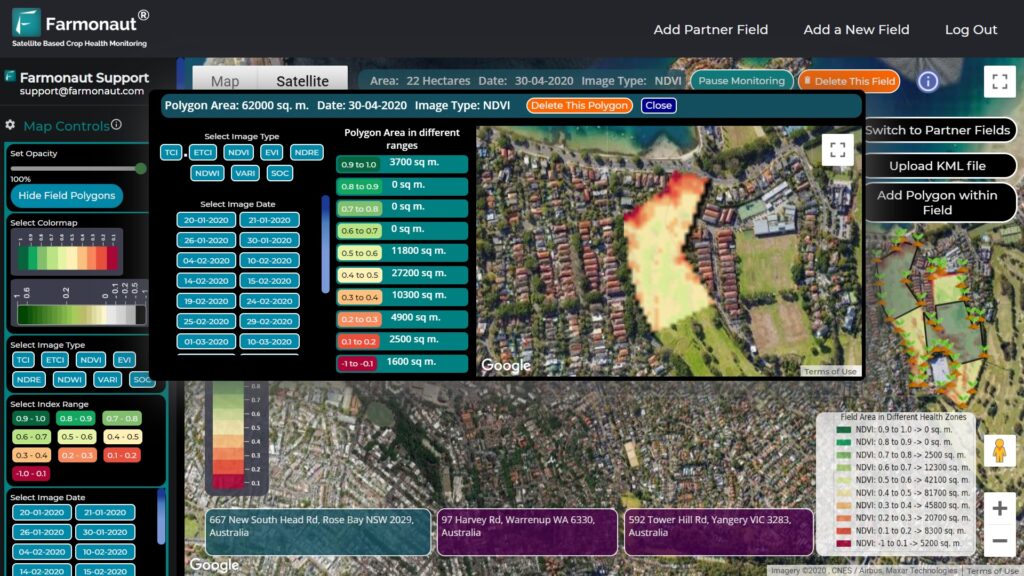
- 📡 Remote sensing technology, GIS mapping, and in-field soil sensing networks are revolutionizing how we track organic matter trends, moisture, and nutrient status across landscapes.
- 🤖 Advanced platforms (like those by Farmonaut) deliver AI-driven advisory and actionable insights to adaptively manage soils and boost resilience.
- 🔗 Visit the Farmonaut API and API Developer Docs for integration of real-time soil and environmental monitoring into your apps and workflows.
Policy Incentives and Regulatory Alignment
- 💸 Soil health incentives—including soil organic carbon credits, erosion control payments, and reclamation performance standards—directly incentivize adoption of better soil practices.
- 🌱 Transparent, digital reporting of improvements and outcomes can qualify land stewards for a variety of sustainable industry certifications.
- 📉 Market pressures increase demand for ESG-compliant (Environmental, Social, Governance) operations, especially in mining and forestry.
Capacity Building Across Sectors
- 👩🏫 Ongoing training in soil health indicators, digital monitoring, and restoration protocols is critical for farmers, foresters, and mine operators alike.
- 📱 Access learning tools and live support via Farmonaut’s mobile & web platforms. Download from your preferred device:



Farmonaut: Satellite Technology for the Future of Soil Management
At Farmonaut, we recognize soil as the linchpin for every successful agriculture, forestry, and mining operation. Our mission is to democratize access to affordable, high-accuracy satellite insights, empowering businesses, governments, and users to monitor, manage, and restore soils—at scale and in real time.
- AI-Powered Monitoring: Our platform uses multispectral satellite imagery to monitor vegetation, diagnose soil health, and detect early warning signs of stress or degradation across vast tracts of land.
- Real-Time Decision Support: Our Jeevn AI system provides tailored, adaptive recommendations for nutrient management, input optimization, and restoration actions directly to your device.
- Blockchain Traceability: For agriculture and mining, our traceability solutions enable transparent, secure documentation of resource movement—from field or mine to market.
- Resource Management: Advanced fleet and resource modules streamline logistics, reduce fuel/emissions, and cut operational costs—critical for large-scale restoration or land preparation.
- Environmental Impact Tools: Our environmental impact features let you track and report on carbon footprinting and emissions reduction progress—an asset for compliance and investor relations.
- Access and Flexibility: Flexible subscription models and API access mean you can integrate Farmonaut’s satellite intelligence into your existing operations—from smallholder farms to multinational resource companies.
FAQ: Soil Management for 2026
What is the role of soil management in reducing climate change impacts?
Soil management increases soil organic matter (SOM), boosting carbon sequestration (turning soils into carbon sinks), stabilizing emissions, and enhancing resilience against climate-related stress like drought and flooding.
How does precision agriculture differ from conventional management?
Precision agriculture leverages data (from soil testing, sensors, satellites) to apply nutrients and water only where needed, maximizing efficiency and minimizing costs and environmental impact—unlike blanket applications with higher losses and emissions.
Are cover crops and crop rotations suitable for all land types?
Most soils benefit from cover crops and diverse crop rotations, though the specific species and timing should be adapted to local soil, climate, and land use. These practices are vital for erosion control, nutrient cycling, and biodiversity.
How do satellite tools like Farmonaut support mining and reclamation?
Farmonaut’s satellite solutions enable remote mapping of soil health, moisture, and vegetation reestablishment after mining. This supports compliance, targeted restoration, and transparent reporting on post-mining land condition.
Which soil management practices offer the fastest improvements for land productivity?
Conservation tillage, organic amendments, and targeted erosion control typically show visible soil health improvements within 1–2 years, raising yields and resilience. Long-term strategies (like agroforestry) generate compounding benefits over time.
Conclusion: Building Resilience, Productivity, and Sustainability with Soil
By 2026 and beyond, sustainable soil management will be the unifying asset across all land-based industries. Proper stewardship is no longer a niche technical concern—it’s the very foundation upon which productive agriculture, resilient forestry, responsible mining reclamation, and durable infrastructure depend.
- 🌱 Use soil health indicators, digital tools, and precision management to guide and optimize every input.
- 🌿 Invest in cover crops, rotations, organic amendments, erosion control, and strategic rehabilitation for immediate and long-term gains.
- 🌳 Embrace perennial systems and agroforestry to secure carbon, biodiversity, and climate resilience on every hectare.
- 🚜 Capitalize on remote sensing and satellite solutions for efficient, scalable monitoring and transparent outcomes.
- 🌍 Stay ahead of regulatory and market trends by elevating your soil stewardship—unlocking higher yields, improved ecosystem services, and lasting resource viability.
Soil management is your pathway to higher productivity, optimized costs, and a sustainable future. Start today—every improvement in soil health multiplies your resilience for tomorrow.