Table of Contents
- Introduction: Precision Agriculture and the Power of Indices
- Trivia: Yield & Water Optimization
- Understanding Leaf Area Index (LAI): Foundation of Precision Agriculture
- Enhanced Vegetation Index (EVI): Monitoring Crop Health
- Normalized Difference Water Index (NDWI): Smart Water Management
- Water Stress Index: Ensuring Resilience in the Face of Climate Change
- Comparative Feature Table: LAI, EVI, and NDWI in Crop Monitoring
- Farmonaut: Driving Remote Sensing Innovation for Agriculture (2026 & Beyond)
- Best Practices and Common Pitfalls in Leveraging Indices
- Conclusion: The Future of Sustainable Yield, Efficiency, and Climate-Smart Farming
- FAQ: Leaf Area Index, EVI, NDWI & Water Stress Indices in Precision Agriculture
Leaf Area Index, EVI, LAI Index & NDWI Crop Success 2026: Leveraging Vegetation Indices for Precision Agriculture
In the rapidly evolving world of precision agriculture, the ability to assess, monitor, and optimize crop health while maximizing yield and sustainability is more critical than ever. The rise of remote sensing technologies and biophysical indices—particularly the Leaf Area Index (LAI), Enhanced Vegetation Index (EVI), and Normalized Difference Water Index (NDWI)—is reshaping how farmers and agricultural managers approach crop management in 2025 and beyond. With climate variability, resource scarcity, and sustainability at the forefront, understanding these indices empowers stakeholders to make data-driven decisions, enhancing productivity and resilience for the future of food security.

“LAI and EVI mapping in 2025 boost crop yield prediction accuracy by over 30% in precision agriculture.”
Understanding Leaf Area Index (LAI): The Foundation of Precision Agriculture
The Leaf Area Index (LAI)—also known as LAI leaf area index or LAI index—is a dimensionless, biophysical index representing the total green leaf area per unit ground surface area. In effect, it tells us how much of the land surface is covered by green leaves, acting as a direct indicator of canopy structure, plant density, and photosynthetic activity.
- LAI measures: Canopy structure, growth dynamics, and overall vegetation vigor
- Critical for: Assessing photosynthetic potential, growth stages, and yield potential
- Enables: Optimized fertilization and irrigation scheduling, minimizing input waste
- Monitored using: Ground measurements, multispectral satellite sensors, and drone imagery
Why is LAI indispensable for modern agriculture in 2026? Because it underpins just about every aspect of crop management:
- Yield Prediction: LAI is directly correlated with crop biomass accumulation and final yields. Knowing your LAI means you can forecast more accurately.
- Irrigation and Fertilization Optimization: Precise LAI readings inform smarter irrigation scheduling and nutrient management, preventing both overuse and under-application.
- Early Problem Detection: Deviations from typical LAI values highlight areas with stress, disease, pest infestation, or other growth issues.
- Sustainable Resource Management: By leveraging LAI, agricultural stakeholders can reduce waste, water, and agrochemical inputs.
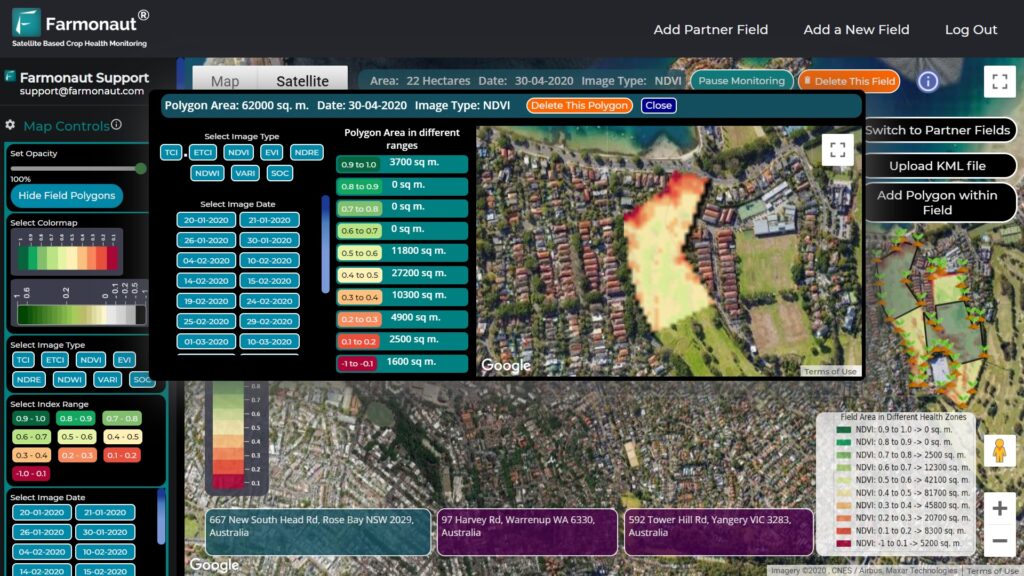
Modern remote sensing platforms, such as those used by Farmonaut, deliver real-time, high-resolution LAI maps—dramatically improving decision-making at the field and regional levels.

🌱 Key Insight
The Leaf Area Index (LAI) is not just for scientists—it’s a farmer’s best friend for optimizing every aspect of crop production, from growth analysis to precision irrigation and sustainability planning.
Enhanced Vegetation Index (EVI): A Deeper Look at Crop Condition Monitoring
The Enhanced Vegetation Index (EVI)—commonly referred to as the EVI Index—improves upon traditional NDVI by minimizing background noise from the atmosphere, soil, and dense canopies. EVI is especially effective for:
- 📊 Photosynthetic Capacity: Measuring vegetation greenness, plant health, and stress
- ✔ Early Detection: Catching subtle crop stress from pests, nutrient deficiencies, or disease before visible symptoms appear
- 🏞 Reliable in Dense Crops: Providing consistent data even in lush, overlapping canopies like rice, maize, or tropical horticulture
- 📅 Time-Series Analysis: Tracking seasonal growth patterns, intervention impacts, and yield forecasts
EVI is particularly useful for high-input, modern cropping systems—in 2026 and beyond, it is the go-to index for precision crop monitoring and digital decision support systems in agriculture.
💡 Pro Tip
Integrate EVI data with LAI and NDWI for a multi-faceted understanding of crop growth, vigor, and moisture stress. This fusion offers early insights—often before stress is visible to the naked eye.
- 🌾 LAI: Canopy structure, growth staging, yield forecasts
- 🌲 EVI: Greenness, photosynthetic activity, subtle crop stress detection
- 💧 NDWI: Vegetation and soil moisture, drought mapping, irrigation scheduling
- 🔥 Water Stress Index: Combines multiple parameters for comprehensive stress diagnosis

Investor Note
Interested in sustainable investment? Farmonaut’s Carbon Footprinting platform leverages indices like LAI, EVI, and NDWI for real-time tracking of agriculture’s carbon impact, supporting compliance and climate-smart finance strategies.
Normalized Difference Water Index (NDWI): The Role of Water in Crop Success for 2026
As global agriculture grapples with water scarcity and climate variability, NDWI (Normalized Difference Water Index) emerges as a vital remote sensing tool for optimizing irrigation and resource management:
- 💧 NDWI Index measures: Vegetation water content and soil moisture at the surface level
- 🌦 Drought & Stress Monitoring: Mapping moisture deficit zones before significant yield loss occurs
- 🚰 Irrigation Scheduling: Precision irrigation—applying water only where, when, and as much as needed
- 🌍 Environmental Stewardship: Reducing over-irrigation, waste, and groundwater depletion—critical in 2026 as sustainability metrics are increasingly regulated
In India, California, and other arid regions, NDWI-driven resource management has transformed both large-scale and smallholder systems. Whether you’re a farmer, agronomist, or corporate ag-investor, understanding NDWI values translates directly into profitable, sustainable agriculture.
Modern platforms like Farmonaut’s real-time moisture monitoring channel NDWI maps into digital irrigation planners—enabling AI-driven scheduling across millions of hectares in 2026.
“NDWI analysis helps optimize irrigation, saving up to 40% water in tech-driven farms by 2025.”
⚠ Key Environmental Note
Meeting 2026 sustainability regulations is easier when your irrigation is NDWI-driven: less water waste, lower input costs, and positive climate credentials.
Example: When NDWI indicates below-threshold values (e.g., NDWI < 0.15), immediate irrigation is recommended, especially for sensitive crops like rice. Conversely, NDWI > 0.5 may suggest excessive soil saturation—a risk for root health—guiding farmers to withhold water or enhance drainage.
Pro Tip for Farm Managers
Need seamless management for hundreds of plots? Farmonaut’s Large Scale Farm Management App provides spatial dashboards—including LAI, EVI, NDWI maps—making precision interventions a breeze for agronomists and farm supervisors.

Water Stress Index: Early Detection for Resilient Crops in 2026
The Water Stress Index goes beyond single-parameter indices by integrating LAI, EVI, NDWI, and thermal data from remote sensing. Its purpose? To deliver a holistic diagnosis of plant water stress and guide targeted interventions for maximum resilience:
- 🌡 Composite Stress Signal: Merges real-time canopy, moisture, and temperature indicators
- 🚨 Early Warning for Drought: Shows stress before irreversible yield losses or damage occurs
- 👨🌾 Precision Breeding & Selection: Identifies fields or varieties with better drought tolerance for future planting
- ⚙ Intervention Triggers: Initiates actions—like extra irrigation, shading, or growth regulator application—based on stress thresholds
- 🔄 Climate-Smart Adaptation: Helps adapt agriculture to increased climate variability and water scarcity in 2026 and beyond
- 🔎 Monitor: Real-time water stress index mapping across fields
- 🆘 Alert: Early warning systems for immediate irrigation or agronomic response
- 🛠 Act: Data-driven management (e.g., variable rate irrigation, row shading)
- 📉 Reduce Risk: Lower crop losses and protect investment
- 🥇 Resilience: Build future-ready, climate-resilient farms

❌ Common Mistake
Relying only on visual signs or single indices. Water stress may occur before any visible symptoms appear. Using a composite approach with LAI, EVI, NDWI, and thermal sensors ensures early, actionable insights.
💼 Fin-Tech Note
For financial institutions offering crop loan and insurance, satellite-based indices are revolutionizing risk assessment. Explore Farmonaut’s Crop Loan and Insurance Verification Tools for more reliable, technology-backed lending decisions in 2026.
Comparative Feature Table: LAI, EVI & NDWI in Crop Monitoring and Precision Agriculture (2025-2026)
| Index Name | Typical Value Range (2025-2026) | Parameter Measured | Precision Ag Application | Suggested Action | Expected Result |
|---|---|---|---|---|---|
| Leaf Area Index (LAI) | 0.5 – 7.0 (arable crops); 2.5–4.5 ideal | Green leaf area per ground area | Growth staging, yield modeling, input optimization | Fertilization, irrigation timing, crop density adjustment | Maximized photosynthesis, yield, optimal input use |
| Enhanced Vegetation Index (EVI) | 0.10 – 0.90; 0.50+ (healthy/canopy dense) | Vegetation greenness, photosynthetic efficiency | Stress detection, vigor mapping, growth trends | Targeted pest/nutrient intervention, variable input application | Reduced losses, less waste, improved crop health |
| Normalized Difference Water Index (NDWI) | 0.0 – 0.7; Ideal > 0.2 for non-stressed crops | Surface & plant water content | Moisture monitoring, drought alert, irrigation management | Schedule irrigation, adjust water volume, activate drainage if high | Water savings, optimal hydration, reduced stress/yield loss |
Access real-time LAI, EVI, NDWI and crop condition maps with

Farmonaut: Driving Remote Sensing Innovation in Sustainable Agriculture (2026 & Beyond)
Farmonaut stands at the vanguard of making LAI, EVI, NDWI, and water stress index data affordable and accessible for everyone—individual farmers to government-level planners. Our platform builds on cutting-edge satellite imagery, AI, and blockchain to deliver:
- ✔ Real-time Remote Sensing: Field-specific maps for all critical indices
- 📊 AI-Based Advisory: Personalized strategies for crop management, climate resilience, and resource savings
- 🌍 Blockchain Traceability: Transparent, tamper-proof supply chains in agriculture (learn more)
- 🚜 Fleet and Resource Management: For efficient, large-scale operations and machinery oversight (fleet management tools)
- 🌱 Environmental Monitoring: Carbon footprinting aligned with sustainability protocols
Our modular, API-first approach supports seamless integration into enterprise farm management systems, making precision agriculture scalable across portfolios of hundreds or thousands of farm plots.
Farmonaut Subscriptions: Unlock Precision Agriculture for Everyone
Choose the plan that fits your scale and needs. Whether you are an individual user, farm enterprise, or government institution, our packages give you access to the latest in remote sensing, AI advisory, and sustainability tech.
- ✅ Pinpoint Early Stress: Act before stress symptoms reduce yield
- ✓ Optimize Inputs: Adjust irrigation & fertilizer only in affected zones
- 🌱 Maximize Yields: Track development and act at the right crop stage
- 📉 Reduce Costs: Lower agrochemical wastage and avoid over-irrigation
- 🔍 Meet Compliance: Document sustainability with index-backed, auditable records for regulators and buyers


Best Practices & Common Pitfalls: Using LAI, EVI, NDWI & Water Stress Indices in 2025–2026
- ✔ Calibrate for Crop & Region: Thresholds (like LAI, EVI, NDWI) are crop-specific—rice, wheat, maize, etc.—and may shift with environment.
- 📊 Use Multi-Temporal Analysis: By comparing index maps weekly/biweekly, you reveal hidden patterns of stress, growth rate, and recovery.
- ⚠ Beware Cloud Cover: Some remote sensing data may miss key events. Whenever possible, combine satellites with ground sensors on critical days.
- 🧬 Integrate Indices: Water stress is best diagnosed with LAI, EVI, NDWI, and thermal metrics together—single-index strategies limit accuracy.
- 👩🌾 Act Promptly: Remote sensing is only valuable if actions follow—build clear response protocols for identified stress zones.
🚩 Common Error
Ignoring index fluctuations between seasons. Always compare index values with historical field data for best decisions!
Forest and Plantation Managers
Monitor tree/crop canopy health at scale. Farmonaut’s Crop Plantation & Forest Advisory Tools bring actionable insights to agroforestry and commercial plantation management.
Conclusion: The Future—Yield, Water, and Sustainability with Vegetation Indices in 2026
To achieve true precision and sustainability in agriculture by 2026, stakeholders must embrace technologies that make the invisible, visible. The union of LAI leaf area index, EVI index, NDWI index, and the water stress index—backed by remote sensing and AI—is at the center of driving:
- 🌾 Higher Productivity: Data-led decisions boost yield and quality
- 💧 Efficient Water Management: NDWI reduces consumption and supports sustainability compliance
- 🌱 Sustainable Inputs: LAI & EVI guide fertilizer & agrochemical reductions, improving soil and environmental health
- 🔐 Risk Reduction: Early stress warnings minimize crop loss and economic setbacks
- 📱 Total Convenience: With platforms like Farmonaut, real-time insights are just a tap away
As we look to the future, precision farming is not just an advantage, it’s a necessity—balancing the need to feed a growing global population with climate stewardship and resource conservation.
Join the revolution and put vegetation indices at the heart of your crop success strategy in 2026 and beyond!
FAQ: Leaf Area Index, EVI, NDWI & Water Stress Index in Precision Agriculture (2026)
-
What is the Leaf Area Index (LAI) and why is it important for my farm?
LAI reflects the total green leaf area per unit ground area. It enables crop health monitoring, guides input use, stages growth, and helps predict yields—critical for both small and large farms in 2026. -
How does EVI differ from NDVI and why is EVI useful for precision agriculture?
EVI is less influenced by background noise and provides more reliable data in dense canopies. In precision agriculture, EVI facilitates early detection of plant stress and tracks subtle variations in crop vigor. -
How does NDWI help optimize irrigation?
NDWI maps vegetation and soil moisture, supporting smart irrigation scheduling. Farms guided by NDWI can save up to 40% in water use, avoiding over- and under-irrigation. -
What is the water stress index?
The water stress index combines multiple satellite-derived indices (like LAI, EVI, NDWI, plus thermal data) to detect plant water stress early and advise on targeted interventions. -
How can I access real-time LAI, EVI, and NDWI maps for my fields?
Use platforms like Farmonaut: via Web, Android, or iOS. Our subscription packages suit all scales. Start now!