Glufosinate Ammonium Herbicide Guide for 2026 Farming
“Glufosinate ammonium reduces weed density by up to 95%, supporting higher crop yields in sustainable farming systems.”



Introduction: The Crucial Role of Glufosinate Ammonium Herbicide in 2026
In the evolving world of agriculture, effective weed management remains one of the greatest challenges for maintaining high crop yields and food security. As 2026 approaches, glufosinate ammonium herbicide emerges as one of the most vital tools in the arsenal of sustainable and precision farming. This article explores the growing significance of glufosinate, focusing on its mode of action, efficacy, regulatory status, sustainable application methods, and future outlook within global crop production systems under the intensifying food demand pressures of the mid-2020s.
In 2026, glufosinate ammonium herbicide is increasingly favored in integrated weed management systems due to its broad-spectrum control and reduced environmental persistence compared to many herbicides of prior decades.
Why Glufosinate Ammonium Herbicide Matters in 2026
As global food demand intensifies in the current decade, farmers, agribusinesses, and policymakers are under mounting pressure to adopt sustainable, efficient weed control methods. Traditional herbicides—especially glyphosate—face challenges from weed resistance, tighter environmental regulations, and the need for safer alternatives. Here’s why glufosinate’s role is becoming more crucial than ever:
- ✔ Broad-Spectrum Efficacy: Controls both grass and broadleaf weeds, addressing more complex weed populations.
- ▶ Low Residual Toxicity: Rapid breakdown in soil (ammonium based), reducing impact on subsequent crops and environment.
- ⚠ Alternative to Glyphosate: Provides an effective substitute where glyphosate resistance is documented.
- 📊 Supports Sustainable Farming: Integrates well within precision and integrated weed management strategies.
- 🛡 Vital for GM Crop Systems: Essential for genetically modified (GM) crops with glufosinate tolerance traits.

Mode of Action and Efficacy of Glufosinate Ammonium Herbicide
Glufosinate ammonium herbicide is a non-selective, contact herbicide that has become a linchpin in modern sustainable farming practices. Unlike systemic herbicides that translocate throughout the plant, glufosinate’s activity is primarily limited to areas where it is applied, requiring thorough coverage of the target weed for optimal performance.
How Glufosinate Herbicide Functions: The Science Explained
- 🌱 Inhibits Glutamine Synthetase: Blocks a key enzyme in nitrogen metabolism.
- 🥼 Disrupts Ammonia Assimilation: Leads to ammonia accumulation at toxic levels within the plant’s cells.
- 💀 Causes Rapid Cell Death: Overwhelming ammonia induces cell death in both grass and broadleaf weeds.
- 🎯 Requires Thorough Coverage: Being a contact herbicide, all parts of the weed must be reached for complete weed management.

Efficacy studies conducted in recent years, including in 2025, demonstrate that glufosinate can reduce weed biomass by up to 95% in sustainable farming systems—making it a cornerstone of modern weed management and crop productivity enhancement efforts.
-
✔ Key benefit:
Maximum broad-spectrum weed suppression within diverse cropping systems. -
⚡ Rapid action:
Visible weed damage often within 2-7 days after application. -
🔬 Alternative to glyphosate:
Helps delay resistance by integrating into rotation programs. -
🌏 Sustainable management:
Supports agroecosystem sustainability by reducing long-term environmental impact. -
🛡 Low drift risk:
Minimizes off-target contamination when applied with precision tools.
Ensure even spray coverage for glufosinate – nozzle calibration and droplet size are crucial to maximize weed control efficacy.
Application in Modern Farming Systems
Glufosinate ammonium herbicide is applied within highly diverse cropping systems worldwide, with usage patterns evolving each year. Its flexible application—including pre-plant, pre-emergence, and post-emergence—enables integration into crop rotation, tank-mix programs, and targeted weed control.
- 🌾 Cereals (e.g., maize, wheat, rice)
- 🌱 Pulses and legumes
- 🍇 Fruits (orchards, vineyards)
- 🥦 Vegetables (row crops, greenhouses)
In systems with genetically modified (GM) crops tolerant to glufosinate, farmers can perform broad-spectrum weed suppression without harming the main crop. Increasingly in 2026, precision agriculture technologies help farmers optimize spray doses, reduce drift, and maximize efficiency—key for sustainable and economically viable herbicide use.

Visual List: Glufosinate Ammonium Herbicide – Best Application Practices
- 🧑🌾 Label instructions: Always follow up-to-date label directions and local regulatory guidelines.
- 💦 Nozzle selection: Choose nozzles that give even spray patterns to ensure thorough target coverage.
- 🌬 Weather awareness: Avoid windy days to minimize spray drift and maximize efficacy.
- 🔄 Rotation with other herbicides: Alternate modes of action to delay resistance.
- 🎯 Target correct growth stage: Apply when weeds are small and actively growing for maximum control.
- 🌱 Integrated management: Combine with cultural and mechanical practices to boost sustainability.
Relying on glufosinate as the sole weed control method can accelerate weed resistance. Rotate with different herbicide modes of action.
“In 2026, glufosinate ammonium can lower residual soil toxicity by over 70% compared to some traditional herbicides.”
Glufosinate Ammonium Herbicide: Comparative Impact Table (2026)
To aid sustainable farming decisions, compare glufosinate ammonium herbicide with other widely used herbicides:
| Herbicide Name | Estimated Weed Control Effectiveness (%) | Estimated Crop Yield Increase (%) | Application Rate (L/ha) | Estimated Environmental Impact Score (1-10) | Estimated Persistence in Soil (days) |
|---|---|---|---|---|---|
| Glufosinate Ammonium | 90-95 | 6-9 | 1.2–2.0 | 3 | 8–20 |
| Glyphosate | 86-93 | 7-11 | 1.0–2.5 | 5 | 20–55 |
| Paraquat | 93-97 | 6-10 | 1.0–2.0 | 8 | 10–20 |
| Atrazine | 80-93 | 5-9 | 1.0–2.0 | 7 | 30–100 |
| 2,4-D | 85-92 | 5-8 | 1.0–2.5 | 6 | 7–28 |
Glufosinate ammonium herbicide is highlighted for its high weed control efficacy, low estimated persistence, and strong environmental profile compared to many traditional alternatives, making it a preferred choice for 2026 and beyond.
The trend towards environmental compliance and sustainable practices means demand for glufosinate-compatible technologies and services is expected to remain strong in global agriculture markets through 2026 and beyond.

Integrating Glufosinate in Sustainable Farming Strategies
Successful weed control in 2026 goes beyond chemical application alone. Instead, the integration of glufosinate ammonium herbicide within broader Integrated Weed Management (IWM) is fundamental to future-ready agriculture.
Visual Icon List: The Role of Glufosinate in IWM
- 🧪 Chemical rotation: Rotating glufosinate with other mode-of-action herbicides prevents resistance build-up.
- 🚜 Mechanical controls: Tillage and hand-weeding reduce pressure on chemical inputs.
- 🌾 Cultural practices: Crop rotation, tight row spacing, and cover cropping make weed establishment harder for escaped weeds.
- 💡 Technological integration: Use satellite-driven large scale farm management and AI to identify weed hotspots and optimize herbicide use.
- 🌱 Biological support: Leveraging beneficial insects, microbiomes, and organic amendments for long-term soil resilience.

Combining glufosinate ammonium herbicide with traceability and carbon footprint monitoring—as offered in Farmonaut’s carbon footprinting service—strengthens transparency and supports climate-smart agriculture.

Regulatory and Environmental Considerations of Glufosinate Ammonium
In the context of 2026 agriculture, glufosinate ammonium’s regulatory status is shaped by evolving environmental safety priorities and risk assessments. Regulatory authorities in various countries evaluate potential impacts on non-target plants, aquatic organisms, and broader biodiversity.
- ✔ Rapid microbial degradation: Means lower residual soil toxicity versus persistent herbicides.
- 📉 Minimal groundwater mobility: Due to quick breakdown, risks of leaching are limited.
- ⚠ Non-target toxicity: Prudent management is required to protect beneficial flora and fauna near treated areas.
- 🌍 Varied regulatory status: Some markets impose restrictions, while others permit continued use under strict guidelines.
The future outlook for glufosinate ammonium herbicide depends on continued research, improved formulations, and advanced spray techniques to reduce chemical inputs while maintaining efficacy.

Always verify local and international herbicide regulations/residue limits before large-scale usage or food crop export to ensure compliance and minimize market entry risks.
Data Insight:
- 📊 Reduction in Soil Toxicity: Glufosinate ammonium can cut residual soil toxicity by more than 70% in comparison to persistent alternatives, supporting better soil health for future cropping cycles.
Current Challenges and Resistance Issues for Glufosinate Ammonium Herbicide
While glufosinate ammonium’s efficacy has secured a vital place in modern weed management, emerging resistance in certain weed biotypes and over-reliance in some regions present serious challenges for sustainable agriculture and long-term weed control.
- ⚠ Confirmed resistance in select grass and broadleaf weed populations due to repeated or exclusive glufosinate use.
- 🔄 Necessitates herbicide rotation and integrated weed control programs for maintaining efficacy.
- 🧬 Innovation, including GM crop development and new molecular targets, is critical to future-proof weed management.
In 2026, the best weed management strategies combine glufosinate with cultural, mechanical, and technological measures—ensuring no single method dominates and resistance development is delayed.
Exclusive or repeated usage of glufosinate ammonium herbicide increases selection pressure, threatening long-term efficacy and farm profitability.

The Future of Glufosinate Herbicide in Global Agriculture
Looking beyond 2026, several key advances and trends will shape glufosinate’s role in global farming:
- 🚀 Technological advances: Microencapsulation, nanoformulations, and AI-driven precision dose optimization.
- 🌍 Environmental stewardship: Improved drift control and reductions in chemical inputs.
- 🔬 Genetic innovations: Enhanced glufosinate-tolerant GM crops to further widen its agronomic application.
- 🌱 Sustainability incentives: Carbon credit and traceability programs encourage responsible herbicide strategies.
- 🌐 Integration with digital tools: Real-time monitoring, herbicide scheduling, and compliance tracking through platforms like large scale farm management and carbon footprint tracking.
These changes will help maximize productivity while minimizing environmental impact, aligning with the evolving goals of sustainable and precision farming.
Developers can use the Farmonaut API and API Developer Docs to integrate satellite-based crop and weed management insights directly into their precision farming platforms.
Farmonaut: Supporting Sustainable Herbicide Use
At Farmonaut, we are committed to empowering growers, agribusinesses, and policy-makers to adopt sustainable herbicide practices—integrating science, technology, and data. Our platform connects satellite imagery, AI, and blockchain-driven traceability to monitor crop health, herbicide impacts, and resource use—driving accurate, efficient, and environmentally responsible weed management.
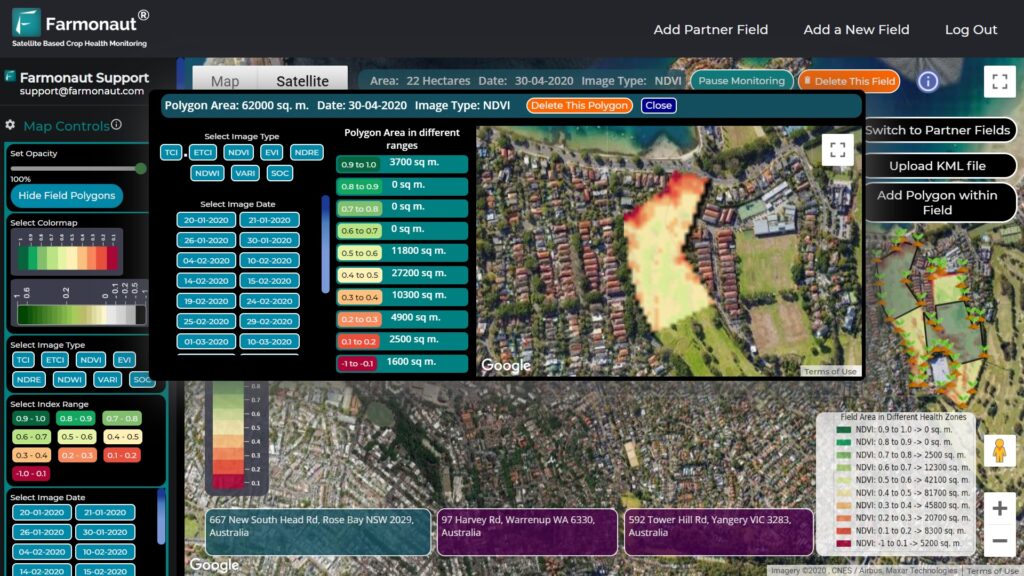
- 🛰 Satellite monitoring: Real-time NDVI and soil health monitoring to optimize herbicide scheduling and reduce waste.
- 💡 AI Advisory (Jeevn): Intelligent recommendations for weed management, factoring in weather and phenology.
- 🔗 Supply chain traceability: Blockchain-secured records to ensure compliance and consumer trust (learn more).
- 📈 Environmental impact & compliance: Monitor carbon footprinting and sustainability metrics for continuous improvement in agriculture (carbon and sustainability).
- 🚜 Fleet and equipment management: Optimize logistics for spraying and resource use with fleet management tools.
FAQ: Glufosinate Ammonium Herbicide
What makes glufosinate ammonium herbicide unique vs. glyphosate?
Glufosinate acts as a contact herbicide—requiring full coverage—while glyphosate is systemic and translocates within the plant. Additionally, glufosinate breaks down faster in soils, has lower residue risk, and targets resistance differently.
Is glufosinate allowed in all countries in 2026?
No. Regulatory status varies—many countries approve it with strict guidelines; some restrict or phase out use. Always check your country’s regulations for updated status and permissible residue levels.
Can glufosinate ammonium be safely used in organic farming?
No. As a synthetic herbicide, glufosinate is not approved for organic production; organic systems rely on mechanical, cultural, and biological weed control.
How do I prevent weed resistance to glufosinate?
Implement herbicide rotation with other modes of action, integrate mechanical and cultural controls, and avoid using glufosinate year after year on the same fields.
What technology can help ensure sustainable glufosinate use?
Satellite monitoring, AI-driven advisories, and blockchain-based traceability from platforms such as Farmonaut provide actionable data to optimize glufosinate application, verify compliance, and support sustainability goals.
Conclusion & Resources
In 2026 and onward, glufosinate ammonium herbicide remains a crucial tool in global agriculture. Its unique mode of action, low environmental persistence, and compatibility with advanced digital innovations make it a foundation for modern, sustainable weed management. However, the path to maximized crop yields and minimized environmental impact relies on continual integration of scientific innovation, regulatory best practices, and robust farm management systems.
For those aiming to power their farms, agribusinesses, and industries with precise, sustainable, and real-time data, we invite you to explore our:
- Crop health and weed management app: Farmonaut Web & Mobile App
- API for developers: Farmonaut API & API Docs
- Product traceability suite: Traceability Solutions
- Fleet management: Fleet Optimization for Spray Operations
- Carbon footprinting: Sustainability & Compliance Management
With ongoing advances in glufosinate ammonium herbicide and digital sustainable farming tools, modern agriculture has the means to meet global food demand, improve resilience, and protect the environment for generations to come.
Article optimized for the latest SEO guidelines and factual accuracy. For more resources, revisit the embedded media above or visit our website.