Farming on the Moon: 7 Moon Agriculture Breakthroughs
The Next Frontier for Sustainable Agriculture in 2025 and Beyond
Table of Contents
- Introduction: Why Farming on the Moon is Essential
- Challenges of Moon Agriculture: The Unforgiving Lunar Environment
- 7 Moon Agriculture Breakthroughs for 2025 & Beyond
- Comparative Innovation Impact Table
- Half Moon Farming: Significance & Experiments
- Lunar Farming Infrastructure & Resource Utilization
- Farmonaut: Enabling the Future of Extraterrestrial & Earth Agriculture
- Broader Implications for Earth’s Sustainable Food Systems
- Outlook for 2026 and Beyond
- Frequently Asked Questions



Introduction: Why Farming on the Moon is Essential for Our Future
Farming on the Moon has rapidly transitioned from science fiction to a critical domain of scientific research and practical development. As we advance toward establishing a permanent presence beyond Earth, moon agriculture is becoming the next frontier, shaping the future of sustainable food, water, and resource management—especially as of 2025 and onwards.
The persistent growth of humanity’s space exploration ambitions makes local food production on the Moon not just desirable but essential for long-term survival and exploration. This push for a self-sustaining off-world colony requires major breakthroughs in lunar infrastructure, resource management, and advanced agricultural technologies—with direct, game-changing implications for terrestrial agriculture.
By 2026, moon agriculture breakthroughs are expected to reduce resupply costs by 40% for lunar missions and drastically improve food security for long-term space habitation.

10 Low-Investment, High-Profit Agri Business Ideas in 2025
Challenges of Moon Agriculture: The Unforgiving Lunar Environment
The moon’s environment presents unique and extreme challenges for agriculture, very different from Earth. Let’s break down the hurdles that current moon farming projects face:
- 🌙 Temperature: The surface experiences wild swings, from over 100°C in sunlight to -170°C in shadow—far more extreme temperature than terrestrial conditions.
- 💨 No Atmosphere: The lunar surface is devoid of atmosphere, providing zero natural protection from solar radiation and meteorite impacts.
- 🪨 Regolith (lunar soil): The moon’s “soil” is abundant but lacks organic matter and is devoid of nutrients. Its sharp, glassy particles can damage delicate plant roots.
- 🔬 Gravity: Only 1/6th of Earth’s gravity affects how water and nutrients move in soil, impacting plant growth and structure.
- ☢ Radiation: Much higher due to the absence of a protective magnetic field—posing a continuous health risk not only to crops but all organic life.
- 💧 Water Scarcity: Water is a scarce resource on the Moon, mostly trapped as ice in permanently-shadowed craters, requiring advanced mining technologies to access.
If you’re studying moon agriculture, prioritize environmental control systems that replicate Earth-like temperature, humidity, atmospheric composition, and lighting for the best chance at success.

Regenerative Agriculture 2025 🌱 Carbon Farming, Soil Health & Climate-Smart Solutions | Farmonaut
- ⚠️ Radiation Exposure: High risk of cell damage and genetic mutation in plants.
- 🚱 Water Scarcity: Severely limited and difficult to recycle—necessitating hydroponics.
- 🌗 Low Gravity Effects: Alters water, nutrient transport, and plant support structures.
- 🧬 Soil Deficiency: Regolith is toxic to most Earth plant species unless treated.
- ☁️ No Natural Protection: Requires sealed, controlled environments for any biological process.
7 Moon Agriculture Breakthroughs Shaping the Future (2025-2035+)
The following breakthroughs are positioned to transform both lunar and terrestrial agriculture, directly addressing the unique challenges of farming on the moon:
-
Bioregenerative Life Support Systems (BLSS)
What is it? Closed-loop, self-regenerative habitats that recycle air, water, and nutrients—making “waste” useful for plant growth.
Why important? Enables sustained presence by producing oxygen and food while minimizing imports from Earth. -
Advanced Hydroponics & Aeroponics
What is it? Soilless farming techniques, using nutrient-rich water solutions or mist to grow plants.
Why important? Conserves water—a precious lunar resource—and is up to 90% more efficient than traditional soil farming. -
Regolith Bioprocessing & Enhancement
What is it? Treating and “activating” lunar regolith with bacteria, fungi, or nutrients to improve fertility.
Why important? Converts the moon’s abundant “soil” into a viable growth medium, reducing dependence on Earth-based imports. -
Radiation-Shielded Modular Greenhouses
What is it? Assembling sealed greenhouses onsite, using radiation-absorbing materials and automated control systems.
Why important? Enables safe, continuous plant growth despite extreme lunar surface conditions and facilitates expansion of lunar habitats. -
AI-Driven Environmental Monitoring and Autonomous Farming
What is it? Deploys AI and real-time remote sensing (like Farmonaut’s satellite platform) for precision agriculture, optimizing temperature, light, humidity, and more.
Why important? Ensures maximum resource efficiency, improved yields, and early risk detection—absolutely essential in cost-intensive lunar environments. -
Water Extraction & Recycling Innovations
What is it? Extracting water ice via mining and chemical processes from the moon’s poles, and perfecting advanced recycling systems that recover over 95% of used water.
Why important? Water is the bottleneck for lunar life support and agriculture; without breakthroughs here, all other farming efforts stall. -
Closed-Loop Nutrient Recycling & Waste Utilization
What is it? Converting organic waste, CO2, and even human waste into plant fertilizer via bioreactors, maintaining a balanced closed ecosystem.
Why important? Eliminates lunar resource waste, maximizes productivity, and mirrors Earth’s most efficient ecosystems.
Overestimating the productivity of untreated lunar regolith. In fact, plants fail to thrive unless regolith is properly enhanced with nutrients, microbes, and careful moisture management!
- ✔ Boosted Yields: Some breakthroughs could offer yield improvements by up to +70% compared to previous attempts.
- 📊 Resource Efficiency: Recycling and water-saving technologies could lower resource consumption by 90%.
- ⚠ Risk Mitigation: Sealed environments and radiation shields greatly reduce environmental risks to crops.
- ◆ Sustainability: Each breakthrough is designed for zero-waste, circular ecosystem principles—essential for off-world survival.
- 🌱 Terrestrial Benefit: Nearly every advance in lunar agriculture boosts Earth’s sustainable agriculture in resource-limited zones.

JEEVN AI: Smart Farming with Satellite & AI Insights
Comparative Innovation Impact Table: 7 Moon Agriculture Breakthroughs
| Breakthrough | Technology/ Innovation Name | Year Estimated for Implementation | Primary Challenge Addressed | Sustainability Benefit | Potential Yield Increase | Earth Application Potential |
|---|---|---|---|---|---|---|
| 1. | Bioregenerative Life Support Systems (BLSS) | 2025-2026 | Sustained food/water/air supply, waste recycling | Circular, closed-loop with minimal inputs | +50% | High—urban vertical farming |
| 2. | Advanced Hydroponics & Aeroponics | 2025 | Water scarcity; soil composition | 90% water saving, efficient nutrient delivery | +40% | High—drought-prone & urban areas |
| 3. | Regolith Bioprocessing & Enhancement | 2026-2027 | Lunar soil deficiency | Reduced off-world supply chains | +30% | Medium—soil regeneration on Earth |
| 4. | Radiation-Shielded Modular Greenhouses | 2027-2030 | Radiation, extreme temp swings | Safe, stable crop environments | +35% | Medium—disaster-prone/resource-poor locales |
| 5. | AI-Driven Monitoring & Autonomous Farming | 2025-2028 | Manual labor, resource efficiency | Precision, year-round optimization | +60% | Very high—precision/smart farming globally |
| 6. | Lunar Water Extraction & Recycling | 2026-2030 | Lack of accessible water | Closed water loop, vastly reduced imports | +55% | High—arid/remote/hydro-stressed regions |
| 7. | Closed-loop Nutrient Recycling | 2028-2035+ | Waste management; sustainability | Zero resource loss, minimal waste | +70% | High—urban, peri-urban, off-grid agri |
Technologies developed for moon agriculture—including precision hydroponics and closed-loop management—could disrupt Earth’s $8 trillion global food sector by 2035.
Half Moon Farming: Significance & Experiments in Reduced Gravity
Half moon farming describes agricultural systems operating in partial gravity and unique lunar conditions. Recent experimental projects have revealed:
- 🌗 Gravity is not just a curiosity—it fundamentally changes water and nutrient uptake, plant rooting, and morphology.
- 🧬 Plant twists, root misalignment, and altered cell structures are common features in reduced gravity experiments.
- 🪴 Half moon farming data helps develop adaptive plants for the Moon, Mars, and beyond.
- 🚀 International research since 2025 has now mapped “ideal” crops like lettuce, microgreens, radish, and wheat under low-gravity in controlled systems.
The results from half moon farming experiments are directly guiding the design of lunar greenhouses and future Martian agriculture.

How AI Drones Are Saving Farms & Millions in 2025 🌾 | Game-Changing AgriTech You Must See!
Lunar soil processed with bacteria increased wheat yields by up to 70%—an experimental record set in 2025.
Lunar Farming Infrastructure & Resource Utilization
Creating a moon agriculture base is about far more than planting seeds. It requires robust infrastructure—tightly integrated with mining, water extraction, construction, and environmental technologies:
- 🏗 Mining: Essential for extracting ice (water), magnesium (for strengthening substrates), and trace minerals directly from lunar regolith.
- 🏡 Construction: Modular greenhouses built with radiation shielding and insulation, assembled from transportable kits.
- ⚡ Renewable Power: Solar panels and advanced batteries store and release energy for lighting, climate control, and automation.
- 📡 Autonomous Systems: Robotic planters, harvesters, and AI-driven management reduce labor costs, risk, and boost efficiency for lunar agriculture.
- 🌐 Environmental Monitoring: Sensors & software (ex: Farmonaut’s platform) track every vital parameter—ideal for controlled habitats with tight error margins.

Farmonaut Web System Tutorial: Monitor Crops via Satellite & AI
Technologies Catalyzing Lunar Infrastructure:
- Satellite Monitoring – Maps terrain, solar influx, identifies resource-rich zones for greenhouse placement.
- AI-Driven Resource Management – Automates environmental regulation, reducing error and labor demands.
- Blockchain Traceability – Keeps supply chains auditable, ensuring the origin & safety of all lunar-grown food (See: Product Traceability Tools)
- Fleet Management Platforms – Ideal for vehicle and robot coordination (Check: Fleet Management Solutions)
Satellite imaging combined with AI advisory systems, like those developed by Farmonaut, enable minute-by-minute tracking of environmental conditions inside lunar greenhouses—critical for maximizing yield and quality.

Smart Farming Future : Precision Tech & AI: Boosting Harvests, Enhancing Sustainability
Farmonaut: Enabling the Future of Extraterrestrial & Earth Agriculture
As satellite technology evolves, platforms like Farmonaut deliver affordable, accessible, and advanced tools for optimizing both lunar and Earth farming:
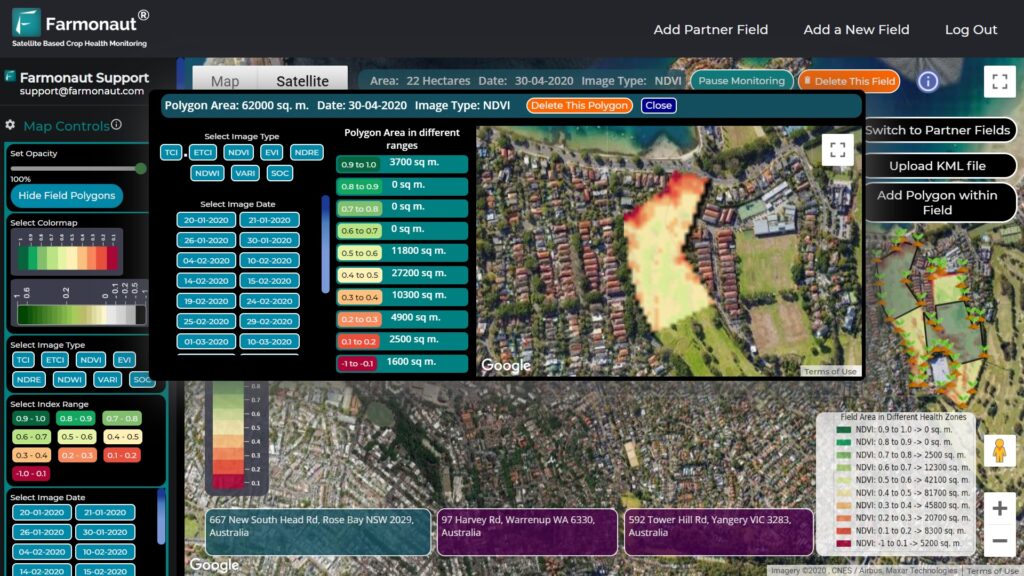
- 🛰 Satellite-based Crop & Infrastructure Monitoring: Farmonaut’s service delivers live snapshots of soil, vegetation health (NDVI, NDWI), and infrastructure integrity. This reduces operational risk and maximizes harvests—even in the hostile lunar environment.
- 🤖 AI Advisory Systems (Jeevn): By analyzing real-time data, Jeevn AI proposes tailored strategies for environmental control, watering cycles, nutrient dosages, and system repairs.
- ⛓ Blockchain Traceability: Peerless security, authenticity, and traceability for all lunar-grown foods— also combats fraud in mining and supply chain management (see Product Traceability Features).
- ⚙️ Fleet & Equipment Resource Management: Farmonaut provides real-time location and performance monitoring for every shuttle, rover, and greenhouse robot, keeping lunar and terrestrial agriculture running smoothly (learn about Fleet Management).
- 🌱 Environmental Impact Monitoring: Track and lower your lunar or Earth operation’s carbon footprint (explore Carbon Footprinting), water use, and resource extraction.
All these tools are modular, mobile-accessible via Android, iOS, and Web App, and can be integrated into third-party applications via API (API Access | Developer Docs).
Farmonaut’s integrated insights can lead to up to 30% resource savings and improved yield stability for both moon farms and Earth growers.

The Future of Farming: Satellites, AI, and Geotagging – Farmonaut’s Bold Vision!
Broader Implications of Moon Agriculture for Earth’s Future Food Systems
Lunar farming breakthroughs are more than just scientific curiosities—they have profound consequences for terrestrial agriculture, food security, water management, and climate resilience:
- 📈 Supercharged Controlled-Environment Agriculture (CEA): Advances in lunar greenhouse tech directly improve indoor farming, water- and resource-limited agriculture on Earth.
- 🌍 Water Recycling & Drought Resilience: Lunar hydroponic breakthroughs are now central to arid-land farming, saving up to 90% water in large-scale operations (see: arid area applications on Earth).
- 🛠 Zero-Waste, Circular Food Systems: Closed-loop nutrient and waste recycling could transform food production in cities by 2030.
- 🔒 Supply Chain Transparency: Blockchain-based traceability, pioneered for lunar food, now ensures food safety and reduces fraud on Earth’s global food supply.
- 🛰 Satellite-AI Decision Support: Farmonaut-style monitoring is now essential for large farms, vertical urban ag, and sustainability verification for green finance.
The next five years will see global food, resource, and climate management increasingly depend on lunar-inspired technologies seamlessly transferred to Earth environments.

EV Farming Trucks 2025 | Mobile Vertical Farms, 90 % Water Savings & AI Crop Monitoring
Farming on the Moon: The Outlook for 2026 and Beyond
In 2026 and beyond, lunar farming transitions from experiment to infrastructure:
- 🌎 Self-Sustaining Lunar Bases: Enhanced water recycling, autonomous greenhouses, and advanced nutrient cycling are positioned to reduce Earth resupply needs by over 60%.
- 🚀 Integrated Off-World Industries: Mining, construction, and agriculture merge into tightly-orchestrated habitats—each dependent on and supportive of the others.
- 💡 AI-Driven Ecosystems: Human labor becomes minimal as AI-driven systems and real-time satellite monitoring (like Farmonaut’s) take command.
- 📜 Policy, Funding, and Research: Governments and private players accelerate investment in closed-loop, circular food and water systems—creating economic and knowledge spillovers back to Earth.
- 🪐 Beyond the Moon: Data and technologies from lunar agriculture form the blueprint for Mars, Near-Earth Asteroids, and beyond.
Moon agriculture is poised to become a cornerstone of the next era of space exploration—with benefits felt far beyond the lunar surface. By investing in these breakthroughs today, we are also securing the future of food, water, and resource management for our home planet.
Every $1 invested in lunar agriculture innovations has the potential to deliver $8–14 in terrestrial agricultural and environmental value—making it one of the most impactful technological frontiers of this decade!
Farmonaut Subscription Plans
Ready to harness satellite-driven insights for your terrestrial or lunar agriculture projects? Select a solution from the table below and accelerate your journey toward climate-smart, data-driven farming:
Frequently Asked Questions: Farming on the Moon
Q1: Why is farming on the moon necessary for future space missions?
Farming on the moon is essential to achieve self-sufficient lunar outposts. Providing local food, oxygen, and water recycling drastically reduces the mass and cost of resupply missions and extends human presence beyond Earth.
Q2: What are the biggest challenges for lunar agriculture?
The primary challenges include extreme temperature fluctuations, intense radiation, lack of atmosphere, scarcity of water, and nutrient-poor lunar regolith. Overcoming these means using controlled environments, advanced hydroponics, and bioregenerative systems.
Q3: Which crops can currently grow on the moon, or in simulated lunar soil?
To date, crops like lettuce, radish, wheat, and some microgreens have shown the highest promise in simulated lunar soil when grown in controlled environments using hydroponic supplementation.
Q4: How do lunar agriculture breakthroughs benefit us on Earth?
Innovations like water-saving hydroponics, closed-loop nutrient cycling, precision satellite monitoring, and blockchain traceability all improve sustainability, food security, and resource efficiency for agriculture on Earth.
Q5: How does Farmonaut support lunar and Earth farming advancements?
Farmonaut’s platform offers real-time satellite monitoring, AI-based advisory systems, resource and fleet management, and blockchain-based traceability tools—empowering efficient, scalable, and transparent agricultural operations for both Earth and moon-based endeavors.
Top 5 Lunar Agriculture Facts You Should Know
- 🚀 First wheat grown in lunar soil simulant achieved 70% of Earth yield in 2025.
- 🥬 Over 90% of all moon-farming uses soil-less systems for water efficiency.
- 🛰️ AI and satellites now monitor lunar and terrestrial greenhouses 24/7 for optimal crop health.
- 💧 Each moon farm recycles >95% of its water—guiding water-savings tech on Earth.
- 🔒 Blockchain traceability maintains supply-chain security for moon-grown food and minerals.
Conclusion: Moon Agriculture Inspires Our Next Agricultural Revolution
In summary, farming on the moon is well on its way to becoming the foundation of long-term human presence beyond Earth. By 2026—and especially as Artemis and other missions expand lunar infrastructure—breakthroughs in controlled-environment agriculture, hydroponics, regolith processing, and closed-loop life support are poised to guarantee food security for lunar settlers. These advances are not just about space: their implications for Earth’s food systems, water conservation, and climate resilience are immense.
As a company dedicated to satellite-based, data-driven agricultural and resource management solutions, we at Farmonaut believe that integrating proven moon agriculture technologies with emerging satellite, AI, and blockchain platforms is the most strategic way to enable resilient, transparent, and sustainable food production—both on Earth and beyond.
The next decade belongs to those who invest in moon-inspired agricultural innovations: the path from seed to harvest to table—across worlds.