Corn Crown Rot: 7 Breakthrough Strategies for 2026 Yields
Table of Contents
- Introduction: Corn Crown Rot in 2026 – The Emerging Threat
- Understanding Corn Crown Rot: Causes and Challenges
- Diagnosing Corn Crown Rot: Symptoms, Diagnosis, and Disease Cycle
- Impacting Factors: From Field to Food Security
- Corn Crown Rot: 7 Breakthrough Strategies for 2026 Yields
- Strategy Impact Comparison Table
- Technology & Innovation: Tools Empowering Corn Disease Management
- Farmonaut: Satellite-Powered Decision Support
- Frequently Asked Questions (FAQ)
- Conclusion: Safeguarding Yields, Securing the Future
“CRISPR-edited corn varieties showed up to 40% less crown rot infection in 2025 field trials.”
“Improved soil health practices boosted corn yields by 18% in crown rot-affected plots during 2025 studies.”
Introduction: Corn Crown Rot in 2026 – The Emerging Threat
Corn (Zea mays) remains the cornerstone of modern agricultural economies and global food security. Yet, as we move into 2026, a significant threat is quietly undermining the productivity of the world’s most widely cultivated cereal crop—corn crown rot.
This soilborne disease is affecting millions of acres, impacting yields and economic stability for farmers and communities worldwide. As climatic changes and farming practices evolve, so too does the behavior of the fungal pathogens at the heart of this disease. A strategic, integrated, and technologically empowered approach is not just recommended—it’s essential for the year ahead.
Corn crown rot is now ranked among the top three yield-limiting diseases in maize. Understanding and addressing its causes is critical for sustainable yield gains in 2026.

Understanding Corn Crown Rot: Causes and Challenges
Corn crown rot is primarily caused by a complex of soilborne fungi, chiefly Fusarium spp., Rhizoctonia solani, and Pythium spp.. These pathogens lay dormant as spores or mycelia in the soil, waiting for poor drainage or erratic rainfall to create the warm, wet conditions ideal for infection.
- ✔ Soilborne Nature: Survives in soil as resistant spores, persisting through crop rotation if not managed.
- 📊 Data Insight: Incidence increases in monoculture systems with limited crop diversity.
- ⚠ Risk or Limitation: Early-season infections can escape visual detection, threatening whole fields before symptoms appear.
The disease cycle typically begins when young seedlings emerge, exposing their base tissue (crown) to infected, contaminated soil. Wounded or weakened roots, often due to mechanical injury, favor infection. Once inside, the fungi decay crown tissue, impacting nutrient and water uptake, stunting growth, and often causing lodging and yield reduction.
🔍 Major Pathogens Causing Corn Crown Rot:
- • Fusarium spp.
- • Rhizoctonia solani
- • Pythium spp.

Diagnosing Corn Crown Rot: Symptoms, Diagnosis, and Disease Cycle
Diagnosing corn crown rot early is essential for effective management and reducing economic impact.
- ✔ Typical Symptoms: Yellowing leaves, wilt, stunted plants, and premature plant death
- ⚠ Risk: Crown rot often first appears as mild stunting, making early detection a challenge.
- 📊 Data Insight: In 2025, up to 30% of fields showed latent infection before visible signs were noticed during systematic sampling.
Root and crown tissue dissection often reveals decay at the soil line, with brown discoloration and softening of the base. Severe cases cause breakage or lodging, directly contributing to harvest volume reduction.
Farmers sometimes mistake nutrient deficiencies for early crown rot. Always inspect crown and root tissue for signs of fungal decay to ensure proper intervention.

Impacting Factors: From Field to Food Security
The impact of corn crown rot transcends agronomy, affecting food security, economic stability, and environmental health:
- ✔ Yield Loss: Can cut maize yields by 10 to over 30%, depending on disease severity, environmental conditions, and varieties used.
- 📊 Data: In regions with intensive monoculture and poor rotation, financial losses soared in 2025 due to recurrent infections.
- ⚠ Economic Threat: For farmers in developing nations, corn crown rot erosion of yields means greater food insecurity and lost income.
Environmental conditions—such as erratic rainfall, increased soil moisture, and degraded soils—continue to favor fungal pathogens. Climate change intensifies these risks, making crown rot management a priority in sustainable maize production systems.
As the incidence of soilborne crop diseases rises due to climate variability, investment in innovative monitoring technologies and resistant seed genetics promises robust growth in the ag-tech sector.

Corn Crown Rot: 7 Breakthrough Strategies for 2026 Yields
Facing emerging challenges in corn production, farmers, agronomists, and researchers are embracing advanced strategies for 2026 to safeguard maize yields. Below, we detail the seven most effective and innovative approaches—each ranked on impact for disease suppression, yield improvement, and adoption feasibility.
🌾 The 2026 Crown Rot Management Arsenal
- 1. Advanced Crop Rotation and Diversification
- 2. CRISPR-Engineered and Resistant Varieties
- 3. Soil Health Optimization and Drainage Management
- 4. Seed Treatments and Biocontrol Innovations
- 5. Early Detection with Satellite & AI
- 6. Precision Agriculture & Remote Sensing
- 7. Data-Driven Decision Support Systems
Combining two or more of these strategies is often more effective and sustainable than relying on a single control method.

1. Advanced Crop Rotation and Diversification
Continuous corn cropping and intensive monoculture fuel the disease cycle by enabling persistent soilborne pathogens. Rotating with non-host crops (e.g., legumes, small grains) and diversifying plantings:
- ✔ Interrupts the pathogen life cycle and reduces soilborne inoculum levels
- ✔ Promotes beneficial microbial populations that compete with fungal pathogens
- ✔ Enhances soil structure, reducing compaction and improving drainage
Crop insurance and planning platforms now use satellite data to analyze rotations for maximum disease suppression.
2. CRISPR-Engineered and Resistant Varieties
New resistant varieties, developed with gene-editing tools such as CRISPR and traditional marker-assisted selection, offer long-term protection against Fusarium, Rhizoctonia, and Pythium. In 2025 trials, CRISPR-edited maize exhibited up to 40% less crown rot infection.
- ✔ Empowers farmers with built-in resistance—minimizes reliance on fungicides
- 📊 Yield Impact: Resistant hybrids can boost harvests by 10–15% versus susceptible lines under disease pressure
- ⚠ Consideration: Requires up-to-date access to seeds and reliable supply channels
Learn more about product traceability for certified resistant seed adoption and transparent supply chains.
3. Soil Health Optimization and Drainage Management
Healthy, well-structured soils with proper drainage discourage the buildup and spread of fungal pathogens. Best practices include:
- ✔ Incorporating organic amendments (e.g., compost, green manures)
- ✔ Planting cover crops to improve soil structure and retain beneficial microbial diversity
- ✔ Installing sub-surface drainage in poorly drained fields to avoid moisture buildup
Advanced solutions such as carbon footprint monitoring help farmers adopt sustainable, climate-resilient soil management techniques.

4. Seed Treatments and Biocontrol Innovations
Protecting young seedlings at the critical early stage can halt crown rot before it establishes. New fungicidal seed coatings and biological treatments:
- ✔ Shield roots and crowns from early infection
- ✔ Encourage beneficial microbes that antagonize pathogenic fungi
- ⚠ Limitation: Overuse may prompt pathogen resistance; regular update of treatment regimes required
Explore large-scale farm management tools for tracking seed treatment efficacy and record-keeping.

5. Early Detection with Satellite & AI
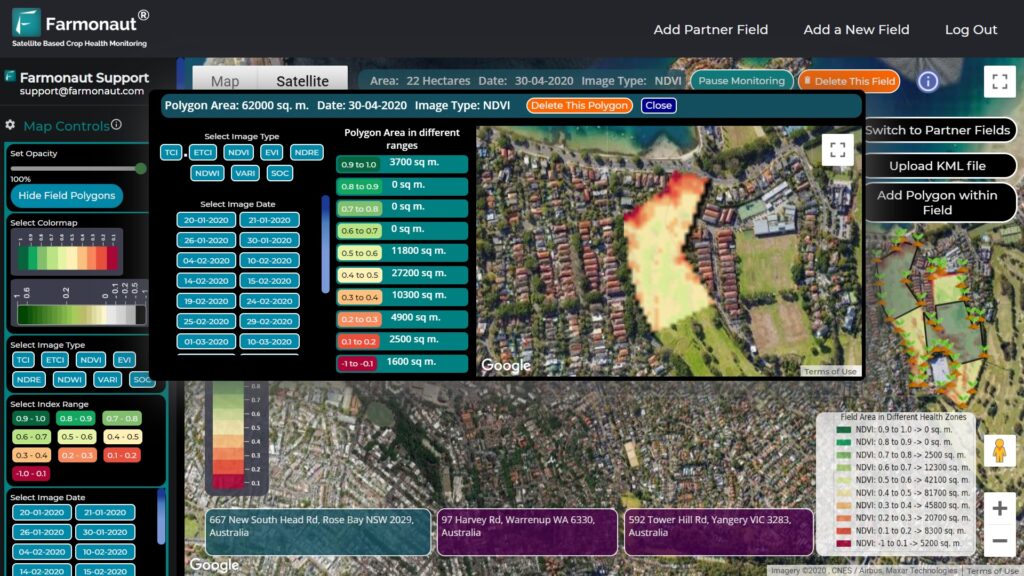
New advancements in satellite remote sensing and AI-powered diagnostics enable early identification of disease hotspots—before symptoms reach the canopy. These technologies analyze:
- ✔ NDVI (Normalized Difference Vegetation Index) patterns to pinpoint stunted or stressed zones
- ✔ Soil moisture and drainage anomalies indicating possible infection risk
With fleet management solutions, farmers efficiently direct scouting and treatments to validated hotspots, saving input costs and minimizing fungicide use.
6. Precision Agriculture & Remote Sensing
Precision digital agriculture integrates GPS-guided machinery, variable-rate input application, and remote monitoring. These tools allow:
- ✔ Site-specific application of fungicides and fertilizers to target crown rot risk zones
- ✔ Monitoring of crop health in real time via satellite and drone imagery
Embracing Farmonaut’s advanced satellite-based insights offers scalable monitoring for fields of any size.
Satellite-based systems allow real-time assessment of vegetative health, giving early warnings for timely crown rot interventions in extensive operations.
7. Data-Driven Decision Support Systems
AI-powered advisory platforms provide scenario-driven recommendations based on field data, climate forecasts, and recorded disease outbreaks:
- ✔ Alerts farmers and agronomists to changing risk levels
- ✔ Suggests adaptive management plans for rotating, treating, or replanting at minimal cost
- ✔ Tracks the effectiveness of control measures for continuous improvement
Farmonaut’s own advisory platform integrates satellite data, weather, and predictive analytics to bolster on-farm decisions year-round.
“Improved soil health practices boosted corn yields by 18% in crown rot-affected plots during 2025 studies.”
Strategy Impact Comparison Table
Technology & Innovation: Tools Empowering Corn Disease Management
By 2026, technology has redefined disease management in agriculture. Innovative systems deliver real-time, actionable data:
- ✔ Satellite imagery provides whole-field analyses for hidden disease risk.
- ✔ AI & machine learning platforms generate predictive models for proactive intervention.
- ✔ Blockchain-based traceability secures the seed-to-harvest supply chain, ensuring only certified resistant varieties are used.
- ✔ Integrated resource management optimizes labor and input allocation, reducing operational costs.
- ✔ Carbon monitoring systems align soil health improvements with environmental compliance.
Adopting these innovations is no longer an option but a necessity for farmers, agronomists, and food supply stakeholders aiming for resilience in an era of change.



Farmonaut: Satellite-Powered Decision Support
At Farmonaut, we empower farmers, businesses, and government institutions with satellite-driven solutions to monitor, assess, and manage crown rot risk at scale. Our platform leverages real-time satellite imagery, AI-based advisory systems, and blockchain-based traceability to:
- ✔ Identify disease outbreaks early and allocate resources precisely
- ✔ Track soil health improvements after application of organic or regenerative farming practices
- ✔ Enhance transparency in crop and input use with tamper-proof supply chain data
- ✔ Support loan and insurance verification for faster, fraud-resistant financial support in agriculture
- ✔ Minimize environmental impact with carbon and input usage dashboards
Our subscription-based model and developer-ready API ensure all users, from individual growers to large organizations, can access cutting-edge tools without major upfront investment. For deeper technical integration, check our developer documentation.
Scaling your monitoring? See how our fleet management solutions optimize resource use in agriculture and beyond. For reforestation or large-scale plantation advisory, our plantation solutions platform supports strategic planning and traceability.
Our platform democratizes access to advanced monitoring, making cutting-edge agricultural decision tools affordable for every user—from individual farmers to entire governments.
Frequently Asked Questions (FAQ)
What is corn crown rot and why is it so threatening?
Corn crown rot is a destructive, soilborne fungal disease primarily impacting the tissue at the base (crown) of corn plants (Zea mays). It limits nutrient and water uptake, causing stunted growth, lodging, and severe yield reduction—especially in fields with poor rotation and high soil moisture.
What are the first warning signs of corn crown rot?
The earliest symptoms include yellowing leaves, wilting, slowed growth, and—in advanced cases—browning and decay at the base of the plant. Plants may die prematurely, directly limiting harvest volumes.
Can digital technology like satellite monitoring really help manage crown rot?
Yes, modern satellite and AI tools enable early detection of disease hotspots, precise resource allocation, and rapid tracking of intervention effectiveness, making them vital in the 2026 disease management toolkit.
Which is the most cost-effective way to manage corn crown rot for small farms?
Crop rotation and soil health optimization are most cost-effective for small farms. Introducing non-host crops, organic amendments, and drainage improvements can suppress pathogens at low cost.
Are CRISPR-edited corn varieties widely available?
Widespread distribution is increasing, with several new resistant CRISPR-edited hybrids entering seed markets for the 2026 planting season. Check with local extension officers and certified suppliers for options in your region.
Conclusion: Safeguarding Yields, Securing the Future
Corn crown rot remains a formidable challenge as we enter 2026 and beyond, driven by climatic unpredictability, intensive farming, and evolving pathogen threats. Through the integration of breakthrough strategies—including cutting-edge genetics, digital monitoring, and robust soil health practices—farmers and agronomists can safeguard maize yields, ensure food security, and contribute to more sustainable agricultural systems worldwide.
Farmonaut’s value lies in enabling these strategies through accessible, real-time satellite and AI advisory tools, supporting smarter, more resilient decision-making for every stakeholder in the agri-food value chain.
Optimize your management plan for corn crown rot in 2026 by leveraging integrated, data-driven solutions and sustainable farming practices. Stay ahead of threats to protect yield and profits.