1960s Tractors, 1970s Tractors: Farming Innovations That Still Power Agriculture in 2025
By Farmonaut Satellite Technology Team
Table of Contents
- The Evolution of Tractors: 1960s and 1970s—A Technological Perspective
- 1960s Tractors: Power, Versatility & the Green Revolution
- 1970s Tractors: Comfort, Safety, Advanced Power
- Comparative Timeline Table: 1960s vs 1970s Tractor Models
- How 1960s and 1970s Tractors Influence 2025 & Beyond
- Farmonaut Technology: Empowering the Next Evolution of Agriculture
- Key Insights and Takeaways
- Tractors, Productivity, and the Future of Efficient Farming
- FAQ: Tractor Innovation & Farmonaut Solutions
The Evolution of Tractors: 1960s and 1970s—A Technological Perspective
Tractors have always stood as the backbone of modern agriculture, steadily transforming farming from a manual, time-consuming practice to a highly mechanized and efficient livelihood. Focusing on the 1960s tractors, 1970s tractors, we discover two pivotal decades that laid the groundwork for our current era of agricultural productivity. These models not only boosted farm power and optimized efficiency, but also set the design philosophies that continue to inspire the advanced machinery of 2025 and beyond.
Understanding the comparative evolution from 1960s tractors to 1970s tractors provides valuable insights into the development of tractor designs, engineering improvements, and how these innovations address both past and contemporary challenges in agriculture. The synergy of power, durability, operator comfort, and efficiency remains central to tractor evolution, shaping not just machines but the entire agricultural sector.
1960s Tractors: Power, Versatility & the Green Revolution
The Shift Towards Diesel Power
The 1960s were a significant shift in the history of tractors. Moving away from basic, low-horsepower models, manufacturers drove a boom in diesel engine adoption, ensuring that diesel engines became the norm, replacing gasoline-powered designs. Why the emphasis on diesel? The answer lies in improved torque, greater fuel economy, and enhanced durability. Most tractors during this period typically ranged from 40–80 horsepower—a notable increase compared to previous, smaller machines.
Key Insight
- ✔ Diesel engines replaced gasoline, bringing greater power, efficiency, and durability to tractor models.
- ✔ Typical 1960s tractors offered 40–80 HP, helping farmers mechanize more tasks and boost productivity.
Rise of Multi-Tasking: Versatility Redefined
Beyond power, the design approach of 1960s tractors focused on versatility. Farmers could use a single tractor for a wide variety of tasks—including plowing, harrowing, planting, and hauling. Integrated synchronized transmissions allowed for smoother gear changes, enabling precision and less operator fatigue. These were not just machines—they were workhorses critical to farm expansion, food production, and mechanization.
The boom of the 1960s tractors coincided with the broader Green Revolution. Mechanization was essential for meeting global food demands, as agricultural production had to keep pace with rising populations and changing market dynamics. With tractors as vital tools, farms became larger, and the scale of operations intensified.
Pro Tip
- 🛠 Synchronized transmissions allowed for gear shifts with minimal disruption, directly reducing operator fatigue during long work hours.
- 📊 Integration of multiple implements enabled one tractor to perform diverse operations—from tilling to transport.
Design and Comfort: The Operator’s Perspective
If there was a limitation in 1960s tractor models, it rested in operator comfort and safety features. While machines were reliable and powerful, ergonomic design was still in its infancy. Tractor cabs were mostly open or semi-enclosed, exposing drivers to dust, heat, cold, and noise. Safety systems such as roll-over protection were rare, leaving skilled drivers at increased risk.
In summary, 1960s tractors became the backbone of expanding, mechanized agriculture—symbols of productivity in fields across the globe. Their power, versatility, and durability set the stage for the enhancements that would define the next decade.
- ✔ Diesel engines for better fuel efficiency
- 📈 Smoother gear changes for reduced fatigue
- ⚡ Higher horsepower for larger implements and workloads
- 🔧 Durable design that remains serviceable today
- 📦 Multi-tasking ability: A single tractor = many tasks



1970s Tractors: Introduction of Comfort, Safety, and Advanced Power
Power Surge: Meeting the Demands of Expanding Farms
As farms grew larger and the need for efficient mechanization amplified, 1970s tractors offered even greater horsepower—frequently over 100 HP in mainstream models. These machines were designed to handle extensive field coverage in less time, maximizing both productivity and profitability.
Investor Note
- 💡 1970s tractors paved the way for high-powered agriculture. Their advanced hydraulic systems and fuel-efficient engines set the stage for cost savings and smarter farming investments—principles echoed in Farmonaut’s Fleet Management solutions for modern agriculture and mining sectors.
Ergonomics and Operator Protection: A New Paradigm
One of the decade’s most vital enhancements was the introduction of enclosed cabs featuring heating and ventilation. This shift provided operator comfort and protection from weather extremes, dust, and noise. Ergonomic seating and intuitive dashboard layouts further reduced operator fatigue.
In response to increasing concerns about safety, roll-over protection structures (ROPS) were introduced—saving countless lives and drastically improving working conditions. This period also saw a focus on hydraulic system sophistication, making attached implements far easier and more precise to control, thus enhancing overall field operations.
- 🔒 ROPS (Roll-Over Protection Structures): Life-saving upgrade.
- 🛋 Enclosed cabs with heating and ventilation for comfort and safety.
- ⚙ Advanced hydraulic systems for precision implement control.
- 💧 Fuel efficiency improved by almost 30%—essential during the energy crises.

Precision and Technology: The Dawn of Digital Controls
Though the era’s electronics were basic by today’s standards, 1970s tractors saw the gradual introduction of electronic controls and monitoring systems. These early digital technologies—monitoring speed, fuel usage, or implement activity—laid the groundwork for the precision agriculture systems and tools now central to smart farming and modern efficiency.
From rugged field machines to increasingly sophisticated workstations, the 1970s set new benchmarks. These innovations were not just about scale—they were about operator well-being and operational excellence, themes that strongly resonate with modern agricultural technology platforms such as Farmonaut today.

Comparative Timeline Table: 1960s vs 1970s Tractor Models
Comparative Highlight
- 📊 Horsepower rose by over 100% from early 1960s to late 1970s.
- 💡 Fuel efficiency increased significantly, with up to 30% operational savings by the late 1970s.
- 🥇 Adoption of safety and comfort features saw dramatic leaps—enabling longer work hours and better operator well-being.

How 1960s and 1970s Tractors Influence 2025 & Beyond
Despite a half-century’s rapid progress, the legacy of 1960s tractors and 1970s tractors remains deeply rooted in agricultural practice. Their foundational designs—emphasizing efficiency, durability, and power—continue to inspire modern machinery, even as today’s tractors embrace digital and autonomous innovation.
Common Mistake
- ⚠ Overlooking the value of older models: In regions where access to high-end, modern machinery is limited, robust 1960s and 1970s tractors are the lifeblood of efficient, productive agriculture—supported by abundant parts and long-standing maintenance know-how.
- ✔ Robust, easy-to-maintain—older tractors serve developing regions and small farms into 2025
- 🛠 Availability of spare parts ensures ongoing relevance in secondary markets
- 💧 Fuel-efficient designs remain critical in regions with expensive fuel or unreliable supply chains
- 🔄 Durability outpaces many modern electronics-dependent models in challenging environments
- 🌱 Key design themes—power, protection, comfort—remain at the heart of today’s innovation
Themes That Endure: From Mechanization to Smart Farming
We observe a continuous thread of key features from these earlier decades:
- Increased horsepower: Foundation for bigger implements and larger acreage.
- Operator comfort and safety: A driver of workplace safety policies worldwide.
- Fuel efficiency: A critical consideration for cost-savings and environmental impact.
- Multi-functional design: Enabling “one-machine-many-tasks” with ease.
- Durability: Longevity and resilience still benchmark modern tractor quality.
The route to 2025 agriculture and beyond is paved by a strong understanding of these evolutions. Today’s tractors feature GPS navigation, autonomous driving, AI analytics, and even carbon footprint monitoring; but these cutting-edge improvements are simply the latest layer atop a history of powerful, operator-focused design.

To better understand this transformation—and to make data-driven decisions on when to repair, upgrade, or replace machinery—today’s agricultural professionals rely on a wide range of monitoring solutions. With Farmonaut’s satellite-based monitoring technologies, it’s possible to optimize resource allocation, track machine utilization, and advance sustainable practices for both old and new tractor fleets.
For example, users can:
- 📊 Monitor operational efficiency of existing tractor fleets with real-time satellite imagery.
- 🔗 Improve traceability of agricultural outputs, using blockchain-based verification from field to supply chain.
- ⚙ Adopt fleet management tools for enhanced machine scheduling, fuel savings, and predictive maintenance planning.

Farmonaut Technology: Empowering the Next Evolution of Agriculture
Leveraging decades of global agricultural evolution, we at Farmonaut continue to build and provide advanced technologies that help farmers, businesses, and governments address ongoing and contemporary challenges. Our solutions directly extend the spirit of 1960s tractors, 1970s tractors: increasing efficiency, durability, productivity, and sustainability.
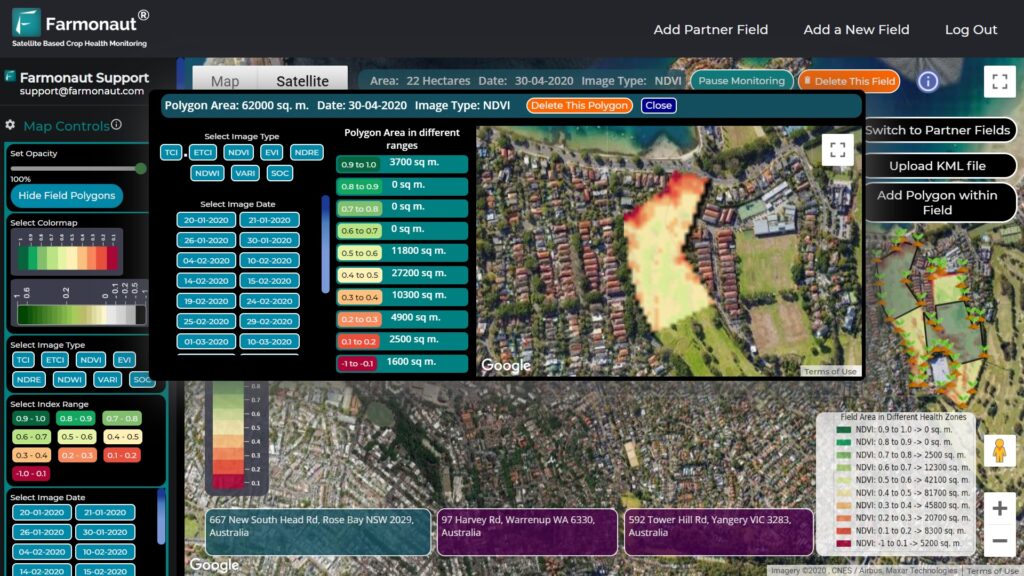
- 🛰 Satellite-based monitoring for tracking crop and machinery status, including NDVI, soil health, and operational efficiency—precision-driven and accessible.
- 💡 AI-driven advisory for crop, fleet, and resource management, improving decision-making just as power steering and electronics revolutionized tractors 50 years ago.
- 🔗 Blockchain traceability for supply chain integrity, echoing the push for safety and reliability first seen in the 1970s.
- 🌱 Carbon footprinting to support climate-smart agricultural practices in line with rising regulatory and market expectations.
- 🚜 Resource management tools that allow accurate scheduling and utilization analysis for both classic and modern machinery.

Affordable, Scalable, and Sustainable Solutions
A major barrier for many agricultural players remains the cost of acquiring and maintaining high-end machinery. Farmonaut enables access to real-time monitoring, predictive analytics, and traceability without expensive on-site hardware. Leveraging satellites, AI, and data integration, our platform extends affordable solutions—supporting small farms, enterprises, and government scaling.
For example, our Large Scale Farm Management tools empower users to coordinate vast networks of equipment, fields, and supply chains—integrating classic tractors with digital oversight for an efficient, modern, resilient 2025 and beyond.

Key Insights and Takeaways: Tractor Evolution from 1960s-1970s
- 1960s tractors set a new benchmark for mechanized power, transforming agricultural practice and paving the way for global food security.
- Technological innovations in the 1970s tractors—especially in operator protection, comfort, and fuel efficiency—remain relevant benchmarks for the agricultural machinery of 2025.
- The ongoing ability to use, repair, and repurpose older tractors supports farm operations in developing markets and during economic downturns.
- Advanced digital solutions, including satellite-based monitoring and traceability tools, extend and enhance the original design traits of durability, versatility, and productivity.
- Understanding and leveraging tractor evolution is key for building resilient, efficient agriculture into 2026 and beyond.
Tech-Forward? Integrate Farmonaut
Integrate Farmonaut’s satellite and weather insights directly into your agribusiness or machinery analytics system:
Tractors, Productivity, and the Future of Efficient Farming
The lessons of the 1960s tractors and 1970s tractors are far from obsolete—they provide the foundational DNA for ongoing innovation on every continent. We see them, not only as milestones of mechanical evolution but as blueprints for building resilient, productive, and efficient agriculture.
- 📈 Tractor models from these decades support millions of acres worldwide—especially where new machines are inaccessible or unaffordable.
- 🕵 Their simple designs permit local repairs and customization, enabling unique adaptations for local farming practices.
- ⚙ The emphasis on power, operator safety, and multi-tasking has become central to the digital and autonomous platforms of 2025 and beyond—echoed in everything from connected sensors to smart implements.
- 📉 Older tractors minimize lifecycle resource demands—a crucial sustainability lesson as climate challenges put pressure on global food systems.
- 🌍 Integration with satellite monitoring and carbon tracking tools (like Farmonaut’s carbon footprinting product) further extends their impact, aligning with a sustainable agricultural future.
Get Ahead with Farmonaut
Ready to enhance your farming operation, fleet, or agricultural service with real-time, scalable satellite solutions? Explore our affordable, subscription-based packages—which support everything from small farms to nationwide monitoring.
Visual Checklist: What Defines Tractor Innovation?
- ✔ Increased Horsepower: Powering larger implements and broader operations
- 👷♂️ Operator Comfort: Enclosed cabs, ergonomic design, low-fatigue seating
- 🔧 Durability: Long-lasting frames and engines, minimal electronics
- 🛡 Safety: ROPS, intuitive controls, and better operator protection
- 🌿 Sustainability: Fuel efficiency and compatibility with satellite monitoring
FAQ: Tractor Innovation & Farmonaut Solutions
Q1. Are 1960s and 1970s tractors still relevant for farmers in 2025 and beyond?
Absolutely. Their durability, mechanic-friendliness, and simplicity make them indispensable—especially for small, mid-scale, or remote regions. With parts readily available and robust basic engineering, they offer resilience that is challenging for some modern alternatives.
Q2. What is the most significant innovation in 1970s tractors?
The most transformative automotive innovation was the movement toward enclosed, climate-controlled cabs and roll-over protection (ROPS), followed closely by advanced hydraulic systems that revolutionized efficiency and operator safety.
Q3. How does Farmonaut enhance tractor and farming efficiency today?
We leverage satellite-based monitoring and AI analytics to track equipment, assess operational efficiency, and guide strategic decisions—minimizing downtime, maximizing resource allocation, and supporting environmental compliance.
Q4. Can I use Farmonaut’s monitoring solutions with older machinery?
Yes. Farmonaut’s platform is compatible across machinery generations. Whether tracking new or classic tractors, our data-driven insights empower both daily operations and long-term strategy.
Q5. How can satellite-driven carbon footprint solutions help farms using older tractors?
Through advanced remote-sensing, we measure and track field practices, inputs, and machinery activity—enabling actionable strategies to balance productivity with emissions control and compliance with growing environmental demands.
Tip for Farm Owners
Pair Farmonaut’s Large Scale Farm Management tools with classic tractor fleets for seamless resource planning, traceability, and compliance in 2026 and beyond.
In conclusion, our understanding of 1960s tractors, 1970s tractors, and their remarkable evolution is not only a source of historical insight but also the fuel for continuous agricultural innovation. The journey from diesel engines to AI-driven satellite platforms demonstrates that every innovation rests on the lessons of those who came before. Whether maintaining classic farm machinery or pioneering smart, sustainable solutions, we champion resilience, adaptability, and forward-thinking design to meet the food and sustainability challenges of 2026 and beyond.
©2026 Farmonaut – Leading the digital transformation of agriculture, inspired by the innovation legacy of 1960s and 1970s tractors.